
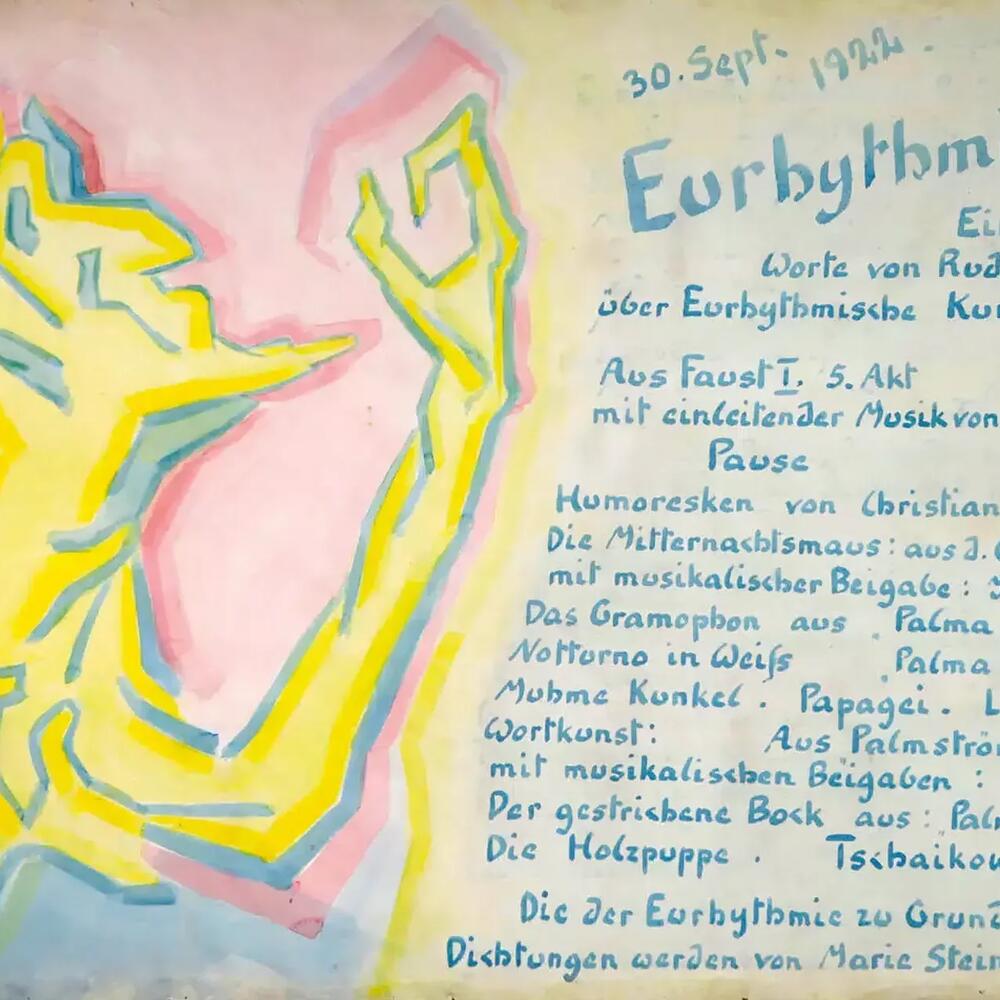
A Colorful Being
Martina Maria Sam and Stefan Hasler have re-edited and expanded all the volumes on eurythmy in the [German] Gesamtausgabe (GA) [Collected Works (CW)]. This work provides a breath of fresh air and a solid foundation for the second century of eurythmy. Here’s a conversation with them and the eurythmist Ulrike Wendt with questions from Wolfgang Held.
Wolfgang Held: All the eurythmy volumes have now been reissued with new commentary: is this the completion of a major project?
Martina Maria Sam: In 2012, Stefan Hasler and Felix Lindenmaier had the idea of reissuing the Tone Eurythmy Course as a textbook with commentary and instructional indications. Then the Rudolf Steiner Nachlassverwaltung [Estate Administration] expressed the wish that the volume be planned as part of the Gesamtausgabe [Collected Works]. But within this framework, it could not be a textbook; instead, it had to be published according to the principles of the Collected Works. This meant that someone familiar with the edition of Rudolf Steiner’s lectures had to be involved. I was asked to take on this role. I remember having some slight reservations at the time, because I was concerned that Stefan, as a eurythmy teacher, might want to add too much of his own interpretation to Rudolf Steiner’s words. I didn’t know him very well yet. It soon became clear, though, that he felt completely committed to Rudolf Steiner’s wording and quickly found his way into the style of the publication.
Was that your first foray into editing?
Stefan Hasler: Yes. Before that, I was engaged in research on tone eurythmy to understand more fully what Steiner had so ingeniously developed in such a concise manner. I had never thought I would become an editor of Steiner’s eurythmy volumes, and yet life led Martina and me along this path over the course of 14 years. We were joined by specialist colleagues whom we brought in: Felix Lindenmaier as a music theorist for the tone eurythmy course, and Dino Wendtland for the eurythmy figures. A small team was formed for each volume.
Sam: Stefan is someone who can quickly grasp the unfamiliar. That was certainly the case here with the editorial work. Over the past years, we’ve gone through all the eurythmy archive material; we’ve had every single note in our hands, including those in the Goetheanum Archive. As a result, two new volumes were added that we hadn’t planned at all—the volume on eurythmy figures and the volume with indications for various languages.
Hasler: We diligently worked through 180 notebooks and 100 loose notes and reviewed all the documents left by the pioneer eurythmists. Sometimes there were three boxes, sometimes twenty. We dug all around, through their whole surroundings; wherever we could find someone from their families—a grandchild or an aunt—we spoke to them and wrote to them. We drove everyone crazy.
Ulrike, what was the response from your eurythmy colleagues?
Ulrike Wendt: I can’t speak for the entire movement. But what has become visible in the new editions of the Speech and Tone Courses has certainly had an impact! Having access to the many notes of the first eurythmists and being able to compare them with my own experiences and struggles is an enormous benefit. For me, it is also an act of liberation—a liberation that comes from looking into the past seriously and carefully.
This text is an excerpt from an article published in the (online exclusive) Goetheanum Weekly. You can read the full article on the website. If you are not yet a subscriber, you can get to know the Goetheanum Weekly for 1 CHF./€.
Title image Poster by Henni Geck for the performance on September 30, 1922, in Dornach