
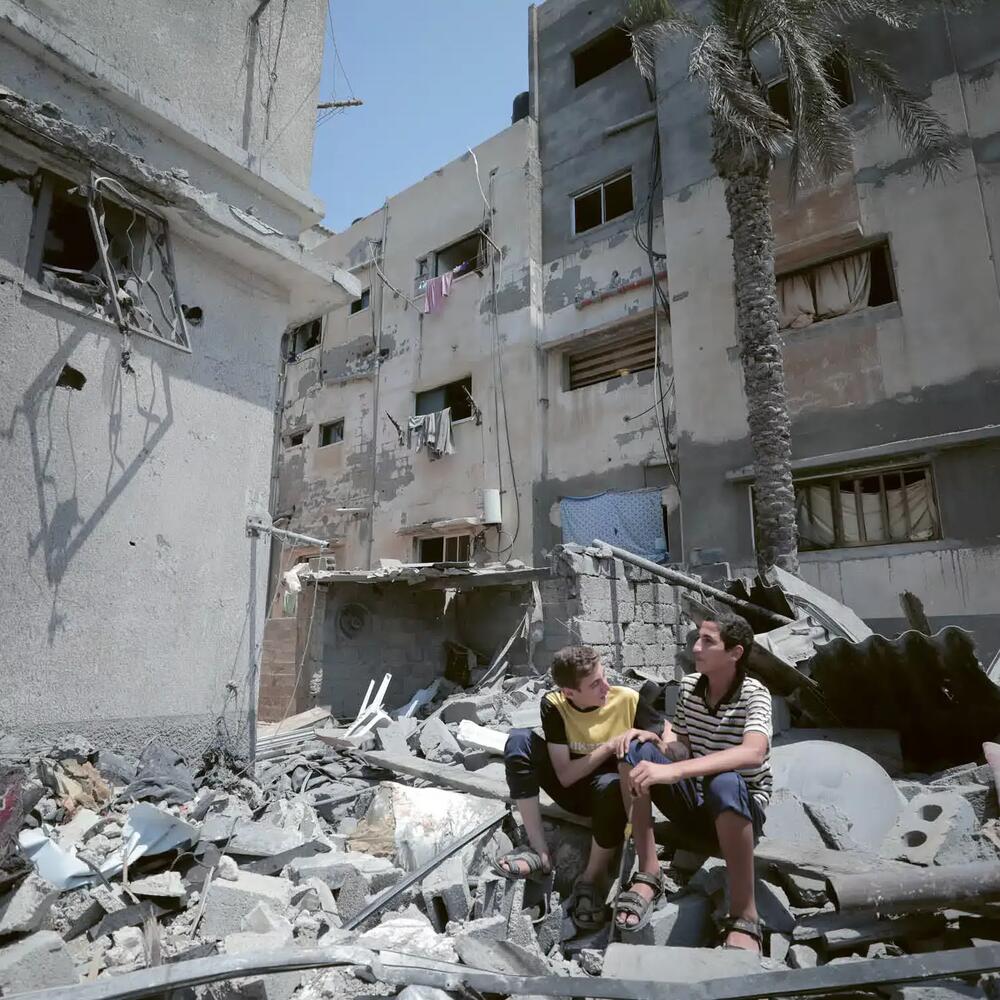
A New Peace Movement?
Are we currently experiencing a breakdown of civilization? How can we restore diplomacy as a first option? Gerald Häfner explores perspectives in these times of war. Questions posed by Wolfgang Held.
How do you perceive the current political situation?
Gerald Häfner: We are in the midst of a kind of breakdown of civilization. A new form of political power is taking hold. It bears traces of totalitarianism. Its goal is self-interest. Success goes to those who thoughtlessly disregard boundaries—both internal and external. Those who still adhere to boundaries and set responsibility for the whole above their own interests appear outdated, helpless, and inept. Take the example of international law: When a German chancellor, asked whether a war of aggression is permissible under international law, dares only to say anxiously that it is a complex matter, we sense how far the erosion of international law has already progressed—even in Middle Europe. International law—the prohibition of crimes against humanity, the prohibition of violence, the protection of the civilian population, respect for human rights, and peaceful dispute resolution—was, at one time, after all, a consequence of our own terrible history of wars of aggression. Today, for many, it is nothing more than empty words devoid of force and effect.
In the increasingly dysfunctional economy of today, we are witnessing the triumph of the super-rich, where economic decline, loss of purchasing power, security, and a future for ever more human beings are present. We increasingly see states as prey to problematic individuals with strong self-interests, little impulse control, and no conscience or compassion. And we are witnessing attempts at political conformity in the media and sciences. These are not easy times!
The philosopher Hans-Georg Gadamer said that if we do not enter a conversation with the assumption that the other person may be right, it’s not a conversation.
This is a crucial presupposition for any successful understanding. I wish it were a guiding principle of political action. With regard to both Ukraine and Iran, the exact opposite is true: talks were broken off in favor of the language of weapons. No one waited to see if an understanding might be possible. Today, war is already the first resort and is then carried out as a “preemptive strike,” as it is euphemistically called.
Isn’t there a contradiction between the prohibition on wars of aggression and the international community’s obligation to intervene in cases of crimes against humanity?
The prohibition on wars of aggression is binding international law—the obligation to protect against genocide and crimes against humanity has recently become so as well. In such a case, the international community would be called upon to act. This is currently being ignored, even consciously circumvented. In the current wars, those in charge have not even consulted their own parliaments, let alone the international community. They are acting of their own accord. It is about property, influence, power, business, and access to raw materials such as oil, gas, uranium, and rare earths. Idealistic goals play a rather minor role.
This text is an excerpt from an article published in the (online exclusive) Goetheanum Weekly. You can read the full article on the website. If you are not yet a subscriber, you can get to know the Goetheanum Weekly for 1 CHF./€.