
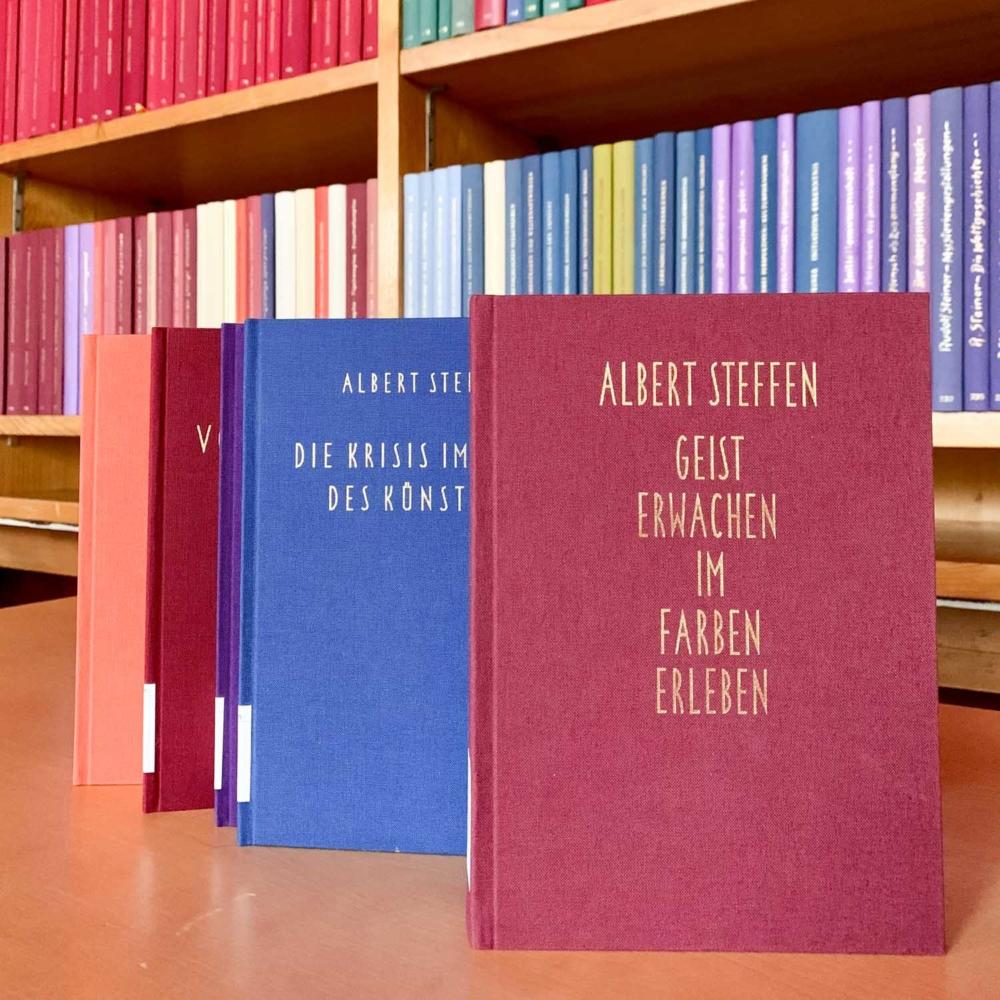
Conscience in the work of Albert Steffen
According to Albert Steffen, spirituality is the price to pay for a truly new poetry. His themes include spiritual dimensions of reality that are otherwise only used in a metaphorical or aesthetic sense.
The composition of his epic and dramatic works deliberately disregards established poetological conventions. With many other authors we seem to be more willing to ultimately find their specific, extravagant and artistic approach legitimate and acceptable.
Reservations based on the author’s worldview
Steffen’s worldview adds to the difficulty in approaching his work. Bertold Brecht’s Marxist orientation, Gottfried Benn’s nihilism or Arthur Schnitzler’s and Stefan Zweig’s psychoanalysis tend to not interfere with our judgement of their literary quality. On the contrary: art and poetry can (and should) be provocative – that is what we expect, even and particularly if they call our own life, thinking and feeling into question. Why should this kind of openness not apply to Albert Steffen?
Steffen’s life and work are based on anthroposophy because he saw in anthroposophy a confirmation and extension of his own spiritual and artistic possibility. Because Albert Steffen, in addition to being an artist, took it upon himself after Rudolf Steiner’s death to be the chairman of the General Anthroposophical Society and because he had to prove himself during those challenging years in the field of tension between the members and the general political situation (for instance the Society’s stance and positioning in relation to national socialism), many of his decisions and declarations in this respect met with incomprehension and sometimes even severe criticism among the membership.
Scrutinizing one’s conscience
Albert Steffen suffered incredibly, as a human being and as someone bearing responsibility for anthroposophy, from this loyally observed obligation, which would eventually also affect his artistic creativity and his health. But he made every effort to achieve a spiritually genuine reconciliation by objectifying the pain inflicted on him and on others in his poetry.
The process of reading sometimes becomes a scrutinizing of one’s own conscience. One may then tend to make writers responsible for what they mirror back to us. In anthroposophical terms, the awakening of conscience and the experience of the true ‘I’ on the other side of the threshold – an experience that needs to be prepared spiritually and meditatively – is for human beings today a becoming aware of the presence of Michael, the Spirit of Time. Albert Steffen’s work prepares this spiritual process artistically and allows it to unfold in the reader.
This contribution consists of edited extracts from the book Poesie und Erkenntnis. Versuch über Albert Steffen [Poetry and knowledge. An essay on Albert Steffen] by Heinrich Schirmer, Verlag Ch. Möllmann, 2020