
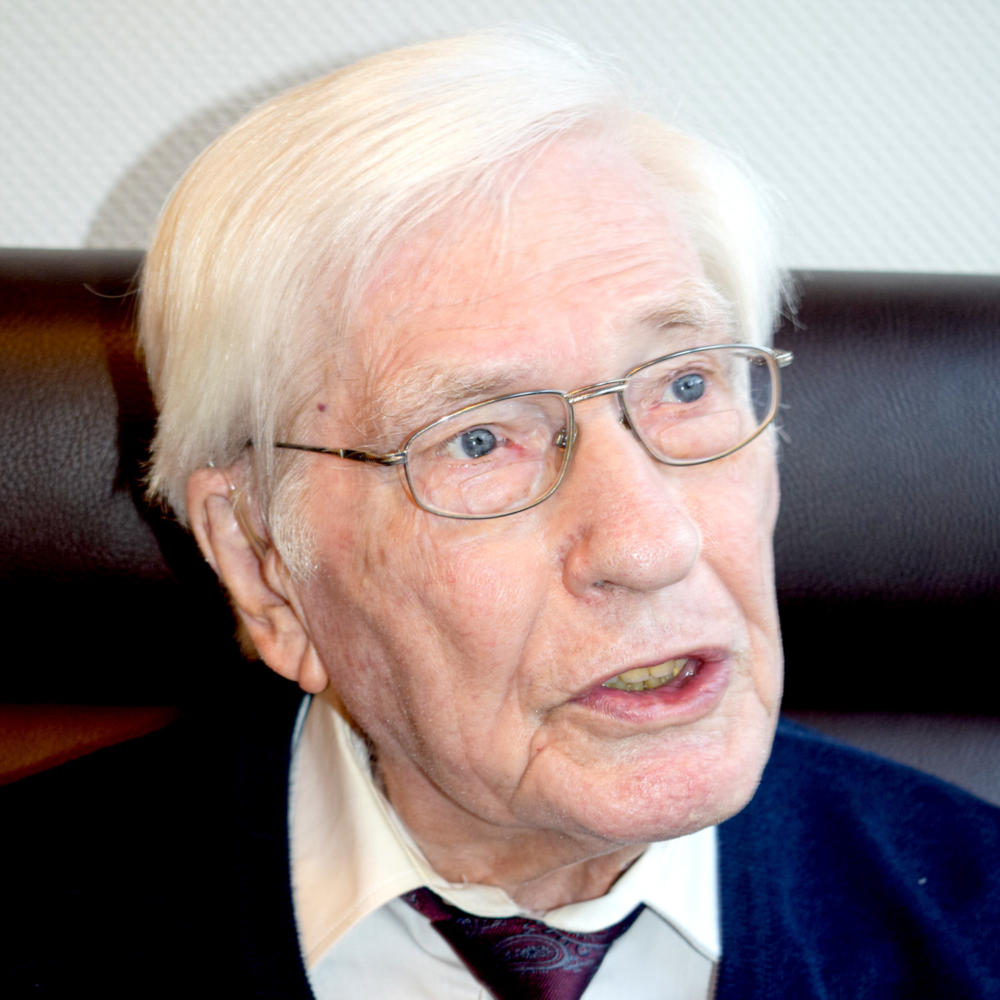
Klaus Dumke
Klaus Dumke (27 January 1925-12 April 2020) was a member of the working council (executive committee) of the Anthroposophical Society in Germany for about 20 years, and since 1964 he gave annual medical seminars in Järna for nurses and prospective doctors during 20 years.
Klaus Dumke was born on 27 January 1925 in Korbach (DE) as the youngest of four children; he had a sister and two brothers. His father was a physician and obstetrician; his mother looked after the family. Klaus Dumke grew up close to nature. When he was fourteen his parents relocated to Schildau (DE). Even before he finished school he was drafted into the army in 1943 and posted to Southern France and Italy as a radio operator. His most dramatic war experience was the explosion of a grenade very close to him. This event, which occurred near Roccasecca Castle, the birthplace of Thomas Aquinas, was something that occupied him until the end of his life.
Medical work
After serving time as a US prisoner of war, Klaus Dumke completed his secondary education and went on to study medicine in Würzburg (DE). There, he also met his first wife. They later married and started a small family in Frankfurt (DE).
In 1952 Klaus Dumke went to Dortmund (DE) where he joined a group of physicians around Hermann Keiner. He acquired his license to practise medicine in the local hospitals which meant that he was very familiar with the city’s medical landscape. In 1958 he took over the practice of Hermann Keiner. This was the beginning of intensive medical activities that included the writing of numerous medical articles on healing plants, anthroposophic therapies, on infections – in particular on Aids. He also pursued his interest in occult epidemiology and moral virulence.
Klaus Dumke had met anthroposophy as early as 1942 – a meeting that was not without danger at that time. In Würzburg (DE) he soon established contacts with other active anthroposophists.
Responsible positions
Klaus Dumke was not only active locally but more widely within the Anthroposophical Society in Germany; he was a council member for more than twenty years. In 1964 he started giving seminars for nurses and medical students in Järna (SE), a task he continued for over twenty years. In the mid-1970s he co-founded the Pedagogical-Social Centre in Dortmund (Hermann Keiner Haus) and was active on several of the Centre’s committees.
Klaus Dumke’s open-mindedness was both a gift and a temptation to spontaneously pursue his many interests. His greatest strength was the ability to communicate with others directly at a soul level. His lectures were imbued with imaginative thoughts. His sense of humour often helped him to overcome the severe episodes of illness that afflicted him in the second half of his life. Inwardly strong and healthy, he suffered from progressive arthritis, mostly of the lower limbs and spine.
He was supported in all his activities, including his medical practice, by his second wife, Marianne.