
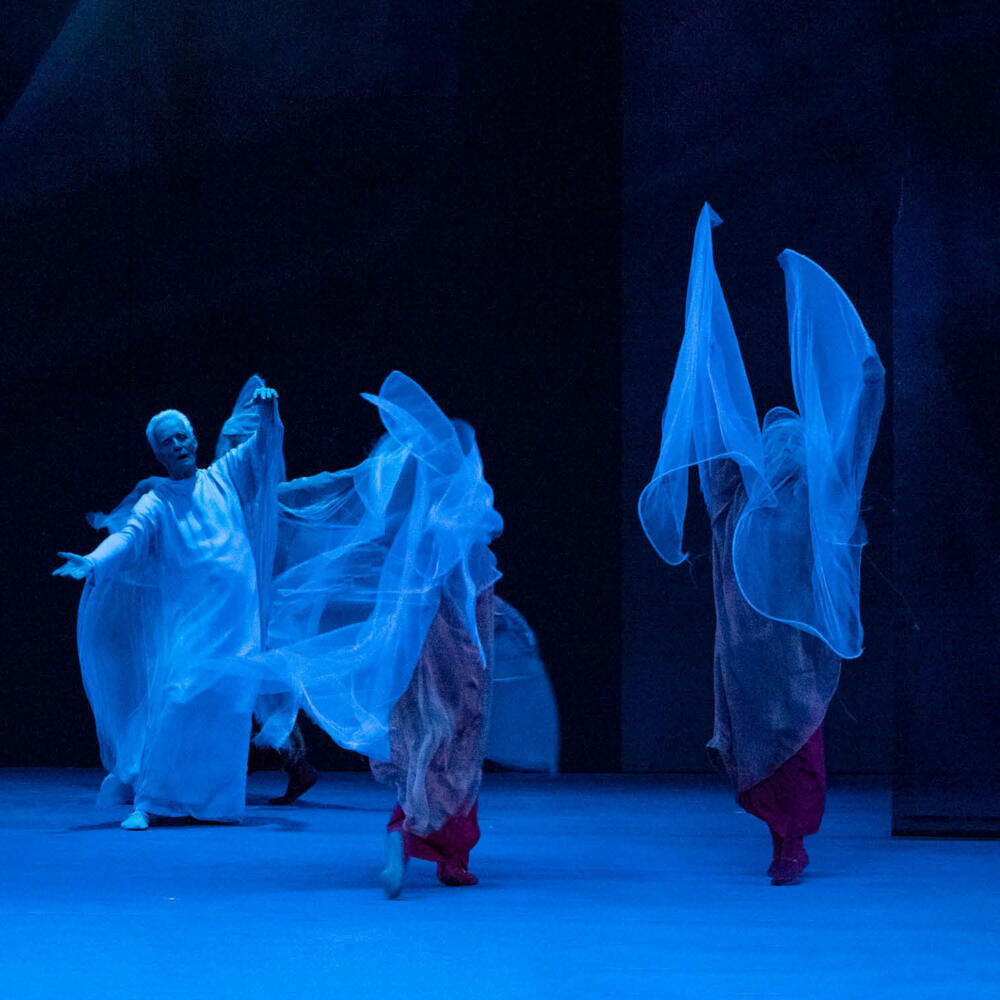
Let Everything Emerge from the Darkness
This Christmas, the current production of Rudolf Steiner’s Mystery Dramas will be performed for the last time at the Goetheanum. We asked Gioia Falk to tell us something about the artistic process behind the production. Questions by Louis Defèche.
How did your work on this production of the Mystery Plays begin 15 years ago?
A group of eurythmists who’d joined the Goetheanum in 2000 asked me, “Can you work on colors with us?” I agreed, gladly. We worked on a few themes related to the movement of color and finally came to the colors of the Mystery Dramas. In the stage directions for World Midnight in the fourth Drama, Rudolf Steiner describes how the group of souls appear—each soul’s head is surrounded by an aura: one is blue with orange stars, another reddish, another blue-yellow, etc. We were inspired by this because it was such an unusual task. And it was wonderful that Rudolf Steiner provided such details on how the moving waves at the back and front of the stage frame the action. Then there was another riddle: “blue-yellow”—that’s not yellow-blue. What’s the difference? Does such a color exist? Can it be found in nature?
And did you find it?
It’s rare. In some sunsets, the sun has already disappeared, but the sunlight still overlays the sky with its last rays. The blue is behind it, and the yellow can no longer shine fully, so it just suffuses the sky. But it’s still not quite green. Sometimes there is a greenish atmosphere during thunderstorms, but in that case, it’s still something different. This is like a selfless yellow that no longer shines fully and lets the sky come through. Maybe there are other instances, but we found this after-sunset moment. And then we realized that this is exactly what Rudolf Steiner described for Theodora. Theodora is in parallel with the character of the bird that still reflects the last rays of the sun in Goethe’s “Fairy Tale.” To find a moment in nature and use it to characterize an entire individuality—that’s remarkable.
Was this also applied specifically to the colors?
Once, when I met the actor Christiaan Stuten, I said, “Look, we’ve worked out the aura of Capesius!” He was interested and astonished, having himself been active with colors and speech for many years. He was the director of the Mystery Dramas at the time and had often played Capesius, so he knew the text by heart. Capesius’ aura is blue, and red or orange impulses repeatedly emerge from this blue. Then we practiced this with him. Suddenly, he said, “Well, when you have the color around you, you actually speak very differently. I also understand the text very differently.” So now we were all truly astonished.
This experience stayed with me; it didn’t end there. Steiner talks about the whole World Midnight as being “floods of colors full of meaning.” “Floods of color”—that’s something we can conceive of abstractly. The colors should change. We’re all familiar with that: a new thought, a new mood, a new color. But, according to the stage directions, it should also be “full of meaning.” Would it be possible to create something tangible, something concrete, from that?
At the time, no one thought of incorporating this into the design of the Mystery Dramas. I was a eurythmist then in Christiaan Stuten’s production. A few years later, in 2008, I was given the task of restaging the Dramas “out of the spirit of eurythmy.” I only used a little of what we’d implemented into movement as color qualities. And yet this work had a fundamental influence as a kind of background for the new concept, especially for the scenes in the spiritual realms.
This text is an excerpt from an article published in the (online exclusive) Goetheanum Weekly. You can read the full article on the website. If you are not yet a subscriber, you can get to know the Goetheanum Weekly for 1 CHF./€.
Imags Mysterien Dramas 2023. Photos: Georg Tedeschi