
Love in Educating
Pole beans need sunshine and so do little children. Anyone who sows pole beans in Switzerland in March won’t be able to enjoy the fast-growing climbing plants.
It’s simply still too cold for them to germinate. Whoever wants to help a sow give birth during the Norwegian winter must seal the barn well and hang an infrared lamp. Anyone looking for investors for a modern sailing ship that brings organic spices and coffee from the Southern Hemisphere to Europe must inspire enthusiasm.
This also applies to education. Whoever takes care of young children in the family or in a childcare setting will not get very far with stress, worry, and profit calculations. With joy, generosity, and a warm relationship with parents, colleagues, and children, favorable conditions for development arise. Steiner observed in 1907 that “joy and delight are the forces that draw out the physical forms of the organs in the right way.”[1] “Cheerful expressions on the educators’ faces and, above all, sincere, unaffected, love. This love brings warmth to the environment and, in the true sense of the word, this love broods on the forms of the physical organs.”[2] Simply put and oft-quoted, but, in reality, a major challenge for life at home, in daycare, and in kindergarten. A colleague from Vienna said that in Waldorf daycare, we need “professional friendship” and “professional love” for parents and colleagues.
Occasionally, love, friendship, and soul warmth bubble up on their own. But for some parents, colleagues, and children, the well runs dry. And yet the small child needs this for his or her unfolding, just like the seeds of the beans. This love and warmth are what make attention and care effective. For educators, therefore, being professional means becoming a sun that always shines on everything—and doesn’t leave the pole beans in the shadows for a day.
I Am the Source of My Warmth
Everything comes down to whether the adult in the daycare and kindergarten can generate love—beyond mere sympathy or antipathy—as an effective feeling through inward activity. It is much more difficult than hanging up an infrared lamp. Carl Rogers has offered many suggestions for cultivating this attitude, which he calls empathy.[3] Much can be found in Rudolf Steiner’s work, too. For example, in the collection of essays, How to Attain Knowledge of the Higher Worlds? (which, when considering many passages, could also be titled, “How to Become a Waldorf Educator?”) he says: As soon as the feeling arises that someone else is the reason why my source of warmth and light is drying up, as soon as I therefore begin to regard them as an adversary to whom I show harshness and coldness, it would be good to ask myself: what can I do myself to clear away the obstacles and restore the source of warmth and light? When a child or a colleague constantly bothers me, I try not to feel hate toward them, but rather ask myself: How can I myself behave so that, in the future, they develop and perhaps no longer bother me?[4]
This text is an excerpt from an article published in the (online exclusive) Goetheanum Weekly. You can read the full article on the website. If you are not yet a subscriber, you can get to know the Goetheanum Weekly for 1 CHF./€.
Footnotes
- Rudolf Steiner, “The Education of the Child in the Light of Spiritual Science,” in The Education of the Child and Early Lectures on Education (Hudson, NY: Anthroposophic Press, 1996), 21; first published in Lucifer-Gnosis, no. 33; now in GA 34 (forthcoming in English).
- Ibid., 22.
- See, for example, Carl R. Rogers, A Way of Being (Boston: Houghton Mifflin, 1980) or On Becoming a Person: A Therapist’s View of Psychotherapy (Boston: Houghton Mifflin, 1961).
- Rudolf Steiner, Knowledge of the Higher Worlds: How Is It Attained?, CW 10, translated by Thomas O’Keefe, Clifford Venho, and Julia Selg (Tiburon, CA: Chadwick Library Editions, 2020), 123: “If I am a teacher and my pupil does not live up to my wishes, then I should first direct my feeling not to the pupil but to myself. I should feel at one with my pupil to such an extent that I ask myself, ‘Is this pupil’s shortcoming not perhaps the consequence of my own action?’ Instead of directing my feelings toward the pupil, I will reflect on what I should do so that in the future the pupil can better live up to my expectations.”
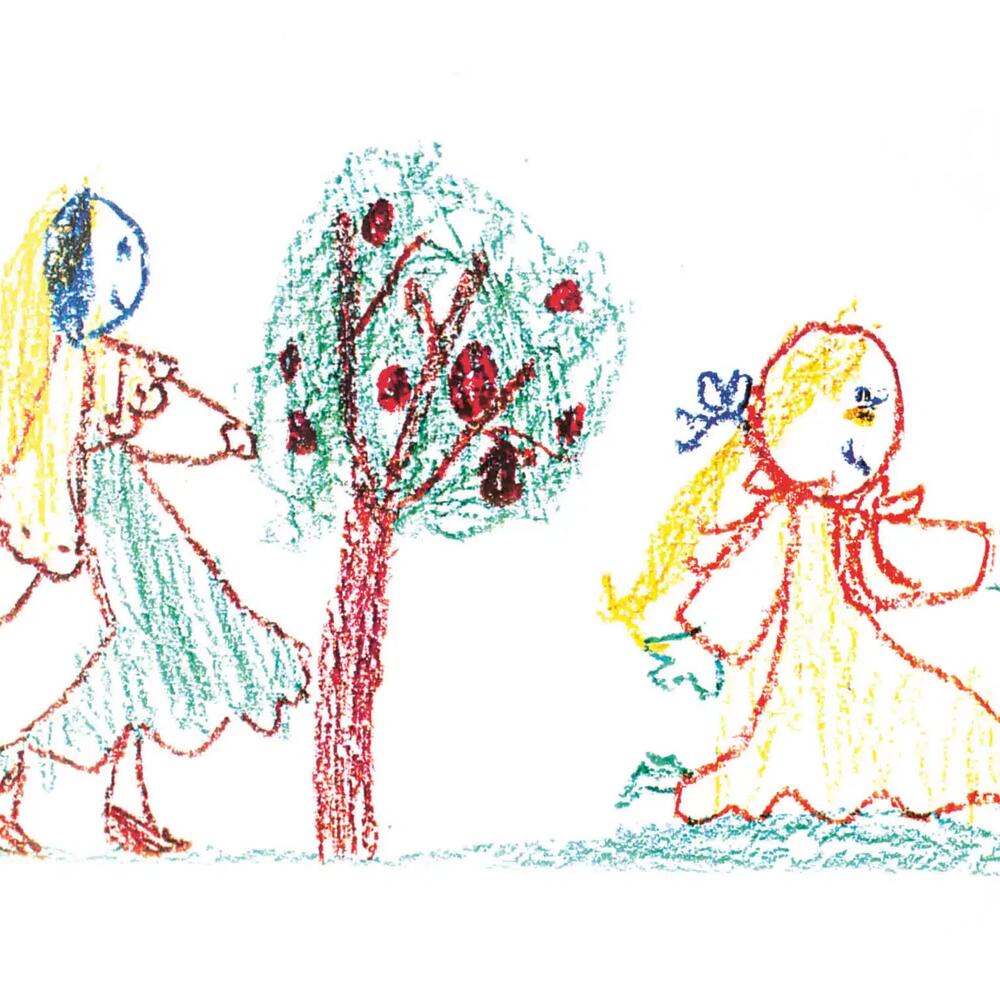
Image Drawing by a 6-year-old girl from Argentina, 1990; Source: ChildArt e.V. Archive