
Productive Tension
The future of anthroposophy relies how we hold its tensions and contradictions. A retrospective on the 100 Years Rudolf Steiner conference, held at Harvard Divinity School in 2025.
anthroposophical medicine, and a century of artistic and esoteric experimentation, Rudolf Steiner’s work remains under-explored in U.S. academia. In October 2023, two researchers of Western esotericism, Henry Holland and Aaron French, wrote to Dan McKanan, director of the Harvard Divinity School Program for the Evolution of Spirituality, proposing a conference marking the centenary of Rudolf Steiner’s death. Two years of thoughtful planning later, researchers from multiple disciplines, practitioners of “applied anthroposophy,” and the general public convened at Harvard in an open dialogue about the life and contributions of this prolific figure. This many-voiced inquiry about Steiner’s legacy suggests that U.S. universities can still function as sites where controversy is metabolized rather than repressed.
Tensions Surface
At the opening reception sponsored by the Anthroposophical Society of America (ASA), General Secretary and President Mary Stewart Adams delivered a reverent welcome that set the ceremonial mood one would expect at an event commemorating Steiner’s legacy. Indeed, Adams, who is also a Star Lore Historian, spoke with a quiet undertone of cosmic significance that filled the hall.
Nevertheless, tensions surfaced almost immediately after the opening keynote by Henry Holland and Aaron French, which examined the polemical context of Steiner’s autobiography. Their academic tone and effort to demythologize and historically situate Steiner were bound to ruffle the feathers of some attendees who may have been expecting a more hagiographic approach. To paraphrase what one audience member wondered aloud, “Why open a conference about the legacy of a spiritual leader like Rudolf Steiner with a politicization of his autobiography rather than expressions of reverence?”
However, Holland and French did not seem to be leveling accusations at Steiner. Rather, they explored the possible motives behind his autobiographical self-representation, particularly as a response to both antisemitic insinuations and false charges that he was of Jewish descent. As they said in response to questions after their presentation, the conference was not intended to be an anthroposophical gathering per se. Its goal was to offer new perspectives on Steiner and critical approaches to his legacy, in order to shed light on this legacy and provide a forum to explore complex issues.
The dual nature of the opening evening—part academic conference, part spiritual gathering—became emblematic of the productive tension that would characterize the rest of the conference: a sustained and thoughtful effort to hold together critical analysis and reverential devotion.
Encountering a Spiritual Stream
For the next 2 days, over 70 speakers from a variety of scientific and artistic disciplines presented in concurrent tracks. What follows is far from a comprehensive treatment of the contributions, but reflects what the authors of this retrospective witnessed and feel was significant.
The meta-question we felt to be hovering over nearly every session was: what does it mean to study a spiritual stream that creatively contests the materialistic norms of contemporary academia while simultaneously carrying what some feel are problematic residues from the European cultural matrix out of which Steiner spoke? In other words, how can we practice a “hermeneutics of reverence,” as Dan McKanan characterizes it? This involves remaining open to the possibility that we may not yet be capable of grasping what cultivated modes of higher cognition illuminate—while at the same time critically examining Steiner’s spiritual scientific work with an alertness to his potential biographical and cultural bias.
This text is an excerpt from an article published in the (online exclusive) Goetheanum Weekly. You can read the full article on the website. If you are not yet a subscriber, you can get to know the Goetheanum Weekly for 1 CHF./€.
More 100 Years Rudolf Steiner, Harvard Divinity School Program for the Evolution of Spirituality
Video 100 Years Rudolf Steiner Conference Interview Sessions
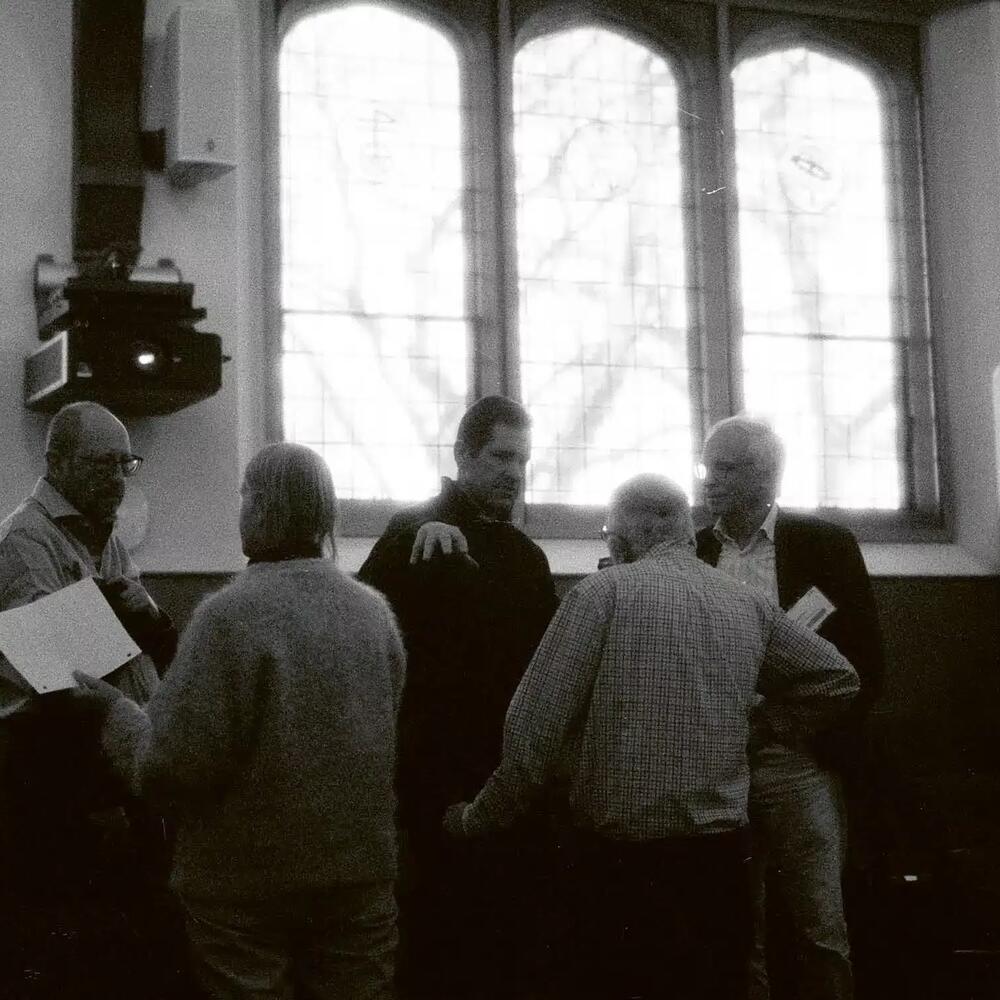
Title image Conference organizer Aaron French speaks with presenters and participants in the lunch room at Harvard Divinity School. Photo: Garret Harkawik