
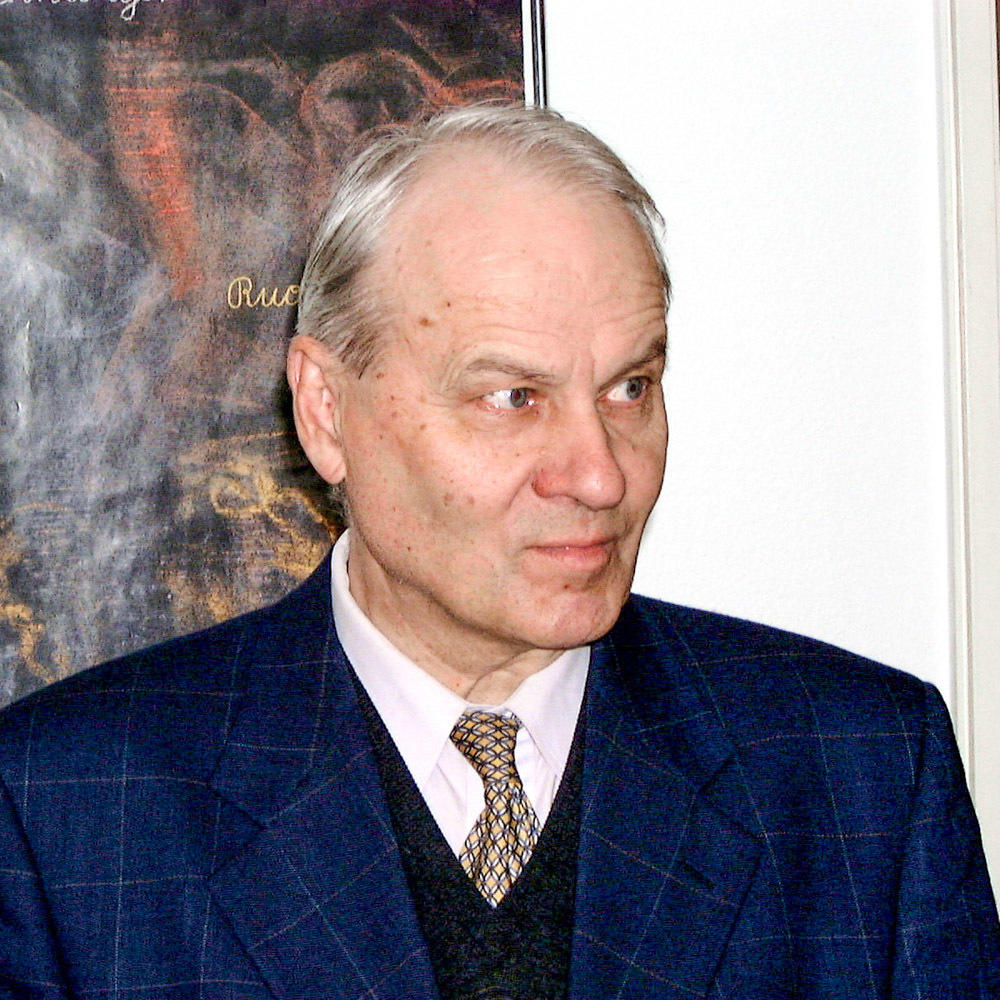
Reijo Wilenius
Reijo Wilenius was born in Helsinki (FI) on 22 April 1930. From his early childhood he remembered the warmth and care of his mother and his father’s attitude that we have to stand up to the trials of life.
At school he was intrigued by philosophy, the thoughts of Arthur Schopenhauer and Friedrich Nietzsche, for instance, or the depths of the poems by Rainer Maria Rilke and T. S. Eliot, the work of Thomas Mann and the images of Egon Friedell.
Independent thinking
Reijo Wilenius read history and philosophy at Helsinki University, starting in 1949. The lectures by Erik Ahlmann would strongly influence his later thinking. The young student was captivated by Jean Paul Sartre’s idea of freedom and by Søren Kierkegaard’s request for independent instead of systematic thinking, as well as by Rudolf Steiner’s philosophy.
After graduating he began to teach cultural history in the university’s department for theatre studies, whilst he continued working on his doctoral dissertation, which was on The Social and Political Theory of Francisco Suarez. From 1962 until 1973 he was assistant professor of social sciences in the faculty for education at Jyväskylä University and lecturer for practical philosophy at Helsinki University.
Reijo Wilenius co-founded the first Waldorf School in Helsinki (Rudolf-Steiner-koulu) and, between 1961 and 1976, he was first a class teacher and then a subject teacher for Finnish, history and philosophy. He had acquired the foundations of Waldorf Education at the Goetheanum teachers’ seminar which he attended with his wife Aijami in the 1950s.
Social commitment
Reijo Wilenius founded a school for critical thinking in Helsinki as a forum for the free exchange on cultural questions, because he had found as a student that it was not always easy to express thoughts that diverged from mainstream scientific views. Reijo and Aijami Wilenius were instrumental in preparing the founding of Snellman University College in Helsinki which opened in 1980. Reijo Wilenius was also president of the European Forum for Freedom in Education; from 1966 to 1996 he was chairman, and from 1966 until 2000 general secretary of the Anthroposophical Society in Finland.
Reijo Wilenius cultivated a lively exchange with Bernard Lievegoed on new ways in adult education which led to the foundation, in 1974, of an adult education seminar. His thoughts on self-development, inspired by Georg Wilhelm Hegel, Johan Vilhelm Snellman and Rudolf Steiner, were also at the heart of his publications, which were aimed at a broad readership, and of his international lecturing activity.
His final work, an autobiography, will be published posthumously.
From an article by Raija Skinnari, compiled and translated from Finnish to German by Seija Zimmermann