
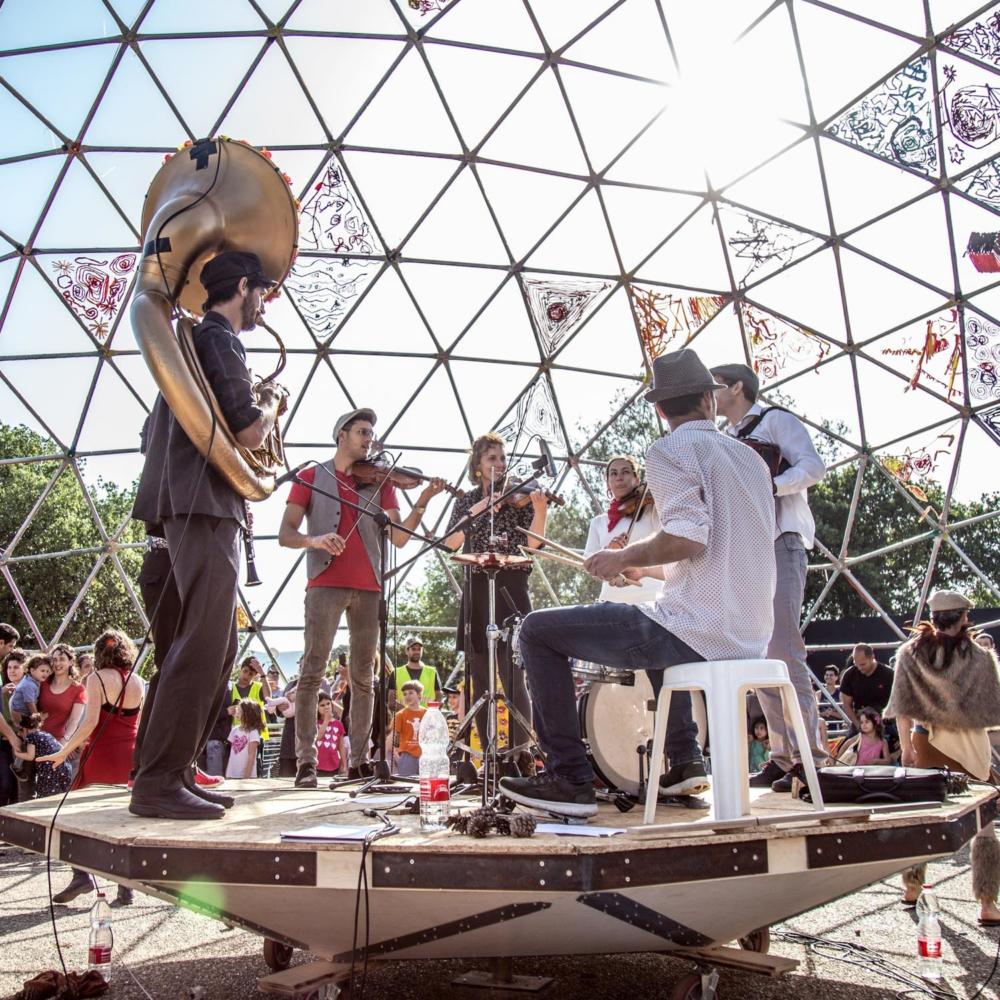
Social impulse on the slopes of Mount Carmel
Four years ago, in addition to the existing anthroposophical initiatives, a new initiative was launched in Tiv'on: the Sheikh Abreik Festival. It has become a model of civil society commitment in Israel, which derives its strength from the impulses of the threefolding of the social organism.
The world is constantly changing; and not only that, but the changes – technological and social – are becoming more intense, rapid and dramatic from year to year. The question is what kind of changes are needed nowadays for the world to change for the better, and accordingly, how to live and apply, in a way that is adapted to reality, the social ideas of spiritual science.
I can talk about what is occurring in my place of residence. Kiryat Tiv'on is a small town of 20,000 inhabitants in the north of Israel. Tiv'on is located at the foot of Mount Carmel, close to Beit She'arim's necropolis (meaning in Hebrew 'The house of gates'], where the Sages are buried. In the 20th century, modern Tiv'on was founded, based on groups of immigrants who built their own homes. The pioneering ethos, volunteerism and self-reliance have characterized the place throughout its existence.
Longing for culture
In the 1990s and 2000s, a branch of the Anthroposophical Society was established here, followed by the local residents establishing Waldorf kindergartens, a Waldorf primary school, a Waldorf high school and anthroposophical education and art trainings. These initiatives have developed around a community-based education of hundreds of families.
In 2017, another development occurred, this time in the cultural sphere: the "Sheikh Abreik Civil Culture Festival" was founded. Our starting point were the insights of the threefold social organism, and the way Rudolf Steiner emphasized the need to free the spiritual life from government-political forces and market forces. How to create a cultural community that defines itself as a culture creator and not merely a culture consumer - out of the freedom of the spirit, in full sovereignty of its creators?
In order to properly build the relationship between culture and the social structure, it is important to return to the source: art and culture spring from the longings and the spiritual impulses that arise in the heart of the individual and the community. Every person - even if this person is not a professional artist - has a longing for a culture in which they can express themselves and develop optimally. And if there is a recipe for joyful action in the world, it depends, for the most part, on two factors - that one does what one wishes for, and together with friends.
Sheikh Abreik Festival
From this, the organizational code of the festival is organically constructed: individual forces are fulfilled through the forces of the community; I help you fulfill your dream, and you help a third person, and the third helps a fourth, and so on. And in order not to fall into the illusion that fulfilling our wishes depends on money, our economic starting point was zero Shekels (nis). The forces with which we help each other are first of all the forces of will, love, vision, creativity, freedom and devotion. Every idea is welcome. Anyone can initiate what they want at the festival – performances, exhibitions, workshops, lectures, meetings, games or parades. It can happen anywhere: in the courtyards of homes, public institutions, streets, shop windows, parks or forests.
In the first festival there were 230 events in three days, a year later – 400 events, and in the third festival there were already 750 events - the labor of about 3000 volunteers – while the fourth was canceled because of the Corona crisis. The economic model has proven itself: a festival whose total cost, in government or commercial production channels – would reach 2 million Euros – was produced, through civilian recruitment, with just tens of thousands.
Thriving of free civic initiatives
The effect on Tiv'on was enormous. It was followed by a thrive of free civic initiatives in the fields of culture, education, environment and social business, and even two political factions stood for local elections – one of which became the largest in the council. Meanwhile, seven more festivals based on the same model were founded in Israel, and the Lottery Fund has created a special criterion for budgeting civilian festivals which 120 bodies and groups throughout the country have approached.
We are currently seeking to take the vision one step further. The festival is by definition non-centralistic - both organizationally (it has no association or legal entity) and geographically (it happens everywhere in the space). But a social organism that operates continually throughout the year needs a home. The idea is therefore to establish a center for civil culture, which will constitute an overall social art work.
The center will operate in the "Kama Flour Mill" at Kibbutz Sha'ar Ha'amakim (meaning in Hebrew 'The gate of the valleys'), near Tiv'on, which was recently renovated by a local artist. We strive to build a social organism that combines different types of human activity - social, artistic, higher educational, ecological, business and technological – and maintain a weave of "bottom-up" free initiatives that sustain spiritual, organizational and economic connections between themselves. And if that goes well, it may create an opening for ideas of spiritual freedom, political equality and economic fraternity – to be integrated into the future organizational thinking of the kibbutz movement. Through all this – one may hope – another door to spiritual social thinking in Israel can be opened.
Translated into English from Hebrew by Daphnee Littman.
Web Sheikh-Abreik-Festival