
The Earth Is the Substance of Our Destiny
We incarnate on a planet whose evolution is intertwined with the destiny of humanity. The “Great Mother” is our body. We have a karmic relationship with the Earth.
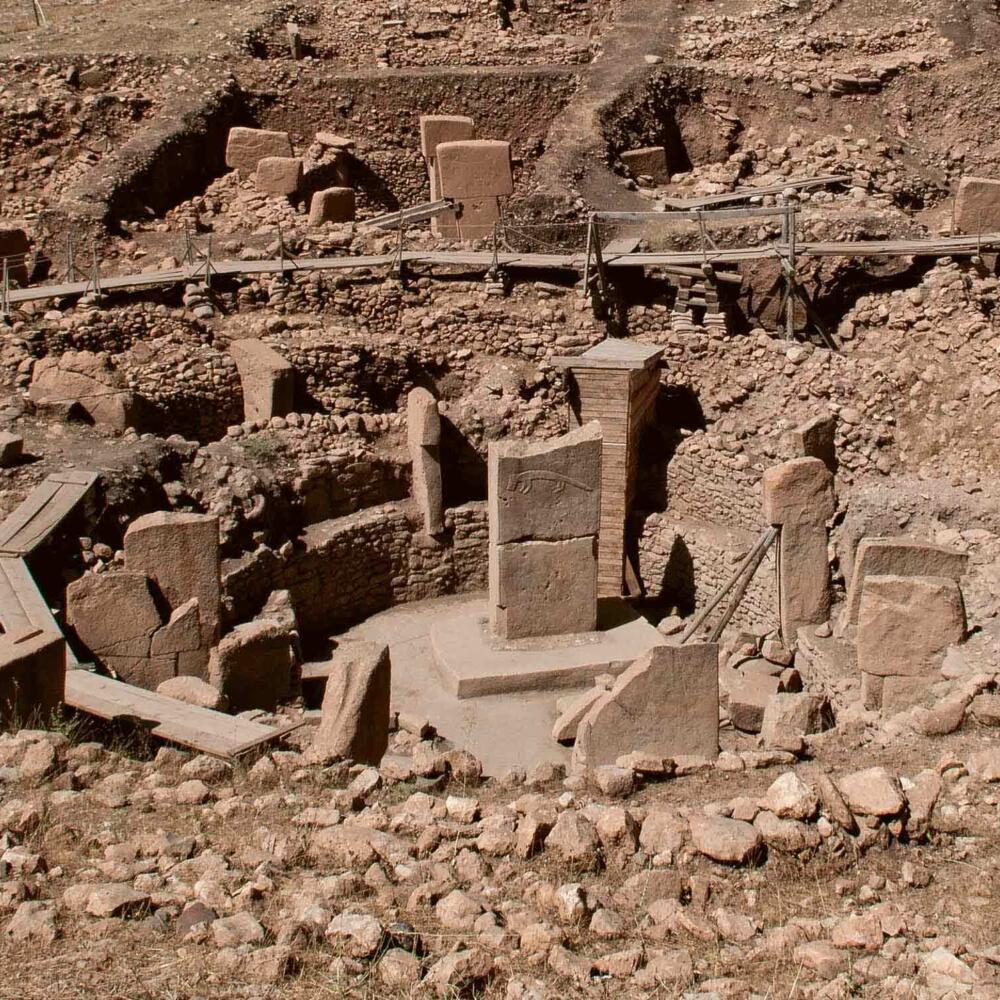
Our primary experience is unity—oneness between self and world. Gradually, duality emerges: child–mother, ‘I’–world, human–Earth. Every day—upon waking—we can try to catch that moment when the ‘I’ again falls out from the unified continuum of experience and ‘I’ and world stand in opposition to one another as separate objects. This awakening to duality occurs time and again throughout our lives; it is an archetypal experience of ourselves as conscious and self-aware human beings. I can recall, for example, how, as a child, lying in a meadow and gazing at the sky, I suddenly realized: the clouds are moving, I am not. For humanity as a whole, this transition took place during the shift from a nomadic life as hunters and gatherers to a sedentary existence approximately 12,000 years ago. An archaeological site that perfectly illustrates this is Göbekli Tepe, located on the upper tributaries of the Euphrates in what is now Southeastern Anatolia, Turkey. On a hill overlooking the plain circular structures are set into the limestone ground. Twelve stone stelae, rising vertically with broad horizontal crossbeams and forming a T-shape suggestive of a human figure, stand in a circle. Between the stelae and connecting them is an oval bench for the community to sit on. In the middle stand two larger stelae anchored in a rock slab. They give an impression that they have not risen from the Earth, but instead have been sent down from the cosmos of the gods. The entire complex speaks, “Here I stand, detaching myself from the interwoven flow of continuous horizontal life within the landscape and with the animals. I stop time and mark a point in space: I, here, now, upright, in the present. I stand and face the earthly world.”
The second stage is an experience characterized by the sense that while I evolve, the earthly world does not; it remains static. As a human being, I proclaim the end of that former initial two-foldness and follow the urge, within and without, to new horizons. “[T]hat splendid stranger with sense-filled eyes, with gliding gait and gently-closed, rich-toned lips”—that is how Novalis describes him.1 And who cannot remember having felt this way in their romantic years? Before it becomes bitterly serious and existential, we ask, “Can I find my way, my entirely individual path, in this world so set in its ways? In this sociologically conservative adult world, in this religiously created world of the Father?” And yes, we felt it can be done. The people of Göbekli Tepe domesticated the wolf and it became a dog—the wild stranger becomes the protector of the self. The multi-seeded grasses are cultivated into heavy, grain-bearing cereals. The soil is furrowed with the plow. Light and darkness, Ahura Mazdao and Ahriman, are brought into encounter. Agriculture proceeds from the Neolithic Revolution.
This text is an excerpt from an article published in the (online exclusive) Goetheanum Weekly. You can read the full article on the website. If you are not yet a subscriber, you can get to know the Goetheanum Weekly for 1 CHF./€.
Image Göbekli Tepe, Şanlıurfa, Türkei, CC BY-SA 3.0