
The spiritual mission of bees
Since the late 1980s, bees have been cared for in a particular way in the Goetheanum’s Natural Science Section. The Section created the foundations for a deeper understanding of bees early on, before the public debate: foundations that can help to strengthen the bees.
It is part of the karma of anthroposophists that many anthroposophical initiatives are born from a particular concern or need. This is also true for the Goetheanum’s way of working with bees. Towards the end of the 1980s, pioneers of biodynamic beekeeping met with Jochen Bockemühl to talk about the spiritual dimension of bees and the ‹appropriate› way of dealing with varroa mites. Imported from India to Europe by a German bee research institute, this parasite has spread rapidly across Europe and is now affecting bee colonies on every continent except Australia.
Liquid gold
In 1996, friends of apiculture together with the Natural Science Section at the Goetheanum organized a conference that featured bee colonies, wild bee hotels, an «apiphone» (box for listening to bees humming) and a honey extractor. Many people had the chance to watch how honey, the liquid gold, is harvested. The great success of this conference was not least due to the fact that it offered so many direct experiences.
In 2014 the Section for Agriculture picked up the topic of bees for its international conference. The response was overwhelming. With 400 people attending, the Schreinerei was full to bursting, and many even had to be turned away. The conference proved that sensitive apiculture exists and is being developed in various ways across the globe. The «bee being» incarnates very differently depending on the continent, cultural background and the intentions of the beekeepers.
The self-image of beekeepers who seek to treat bees appropriately has changed noticeably. The early struggles have given way to a sense of admiration and reverence. This change is also part of karma. It does not mean that beekeepers have lost sight of the serious problems surrounding not only the bees but all pollinators, on the contrary: the biodynamic movement has rarely been as active, socially and politically, as its beekeepers are now. They demand the rigorous reduction of pesticides and herbicides in farming, fight court cases against the use of particularly harmful insect poisons, launch petitions and request crucial structural changes in farming.
At the same time the underlying mood has changed. The work with bees is no longer motivated by the threatening environmental crisis. Bees are not kept in spite of, but with all the problems – the combative mood has turned into respect, sympathy and love.
Bee research
In 1996, bees were for the first time the subject of a research project in the Natural Science Section. Before that, Daniel Kuster, who works in the Goetheanum garden department, and I had discovered why there were no more butterflies in the meadows around the Goetheanum. We started using a method called «mosaic mowing» which helps to create new habitats. It was not long before 20 butterfly species appeared that had not been seen for decades (some were actually on the Red List). Even the colleagues at Basel University (CH) were surprised.
I had no specific apicultural knowledge but thought that a paradise for butterflies had to be a paradise for bees too, and so I proposed a project that was then put into practice together with the beekeepers Martin Dettli and Xaver Wirth. The title of the project was «Beekeeping without chemical varroa treatment». We must have been the first researchers in Europe to investigate whether bee colonies can survive the mites without the use of medication. Only one colony survived for six years, but generally we had to document the dying of bees.
This project marked the beginning of research into bees that is still ongoing today. Martin Dettli examined the conditions that support varroa tolerance; I started a study on improving colony health by mixing mistletoe and Echinacea into the bee food. Presently, Eva Frey of Fischermühle, a bee research and teaching institute in the south of Germany, and I are investigating how varroa-tolerant behaviour is passed on among the colonies. Together with Benjamin Epler, a developer of biodynamic preparations, we are also testing a new treatment that involves working mite ashes into beeswax.
Teaching about bees
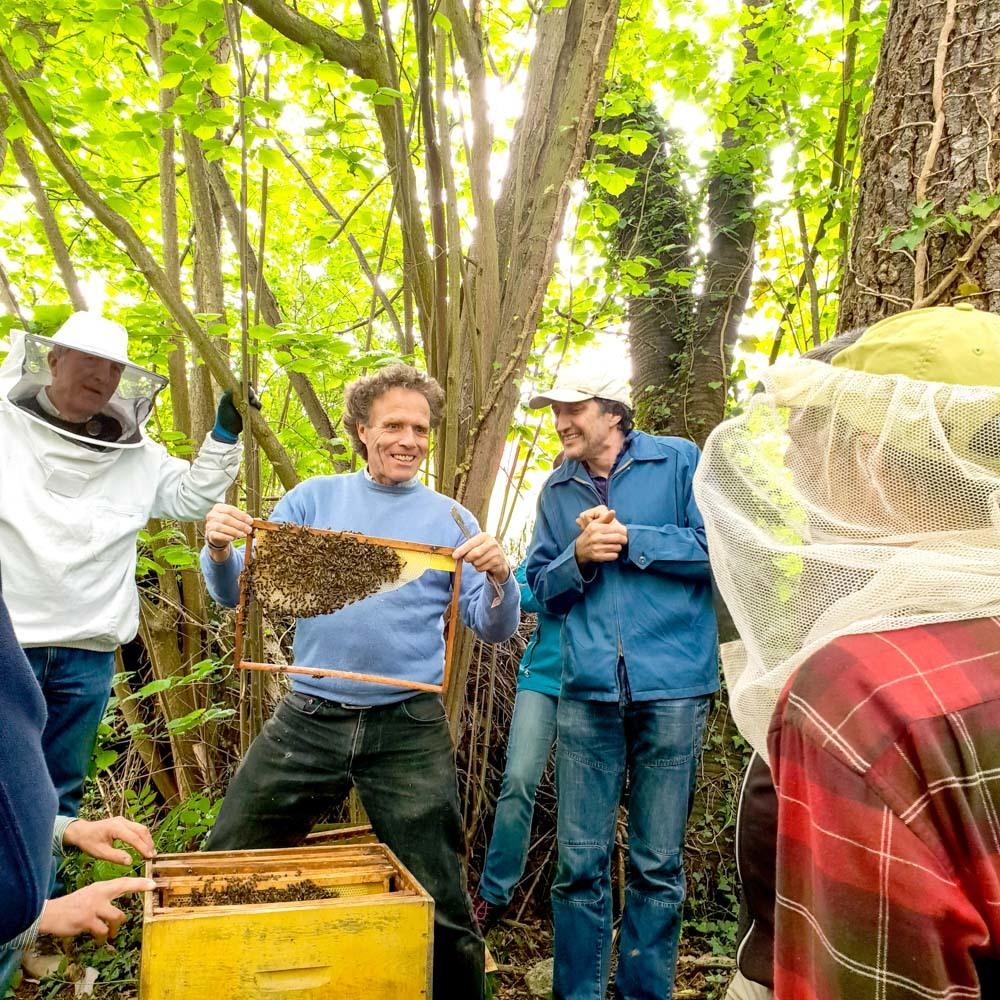
The teaching on campus, too, is no longer conceivable without bees. They are part of the Goetheanum Studies and provide much appreciated observation experiences in seminars with both amateurs and experts. The introductory course «The beehive impulse» that stretches across six Saturdays in the apicultural year conveys basic insights into sensitive bee-keeping. Members of the medical professions are interested in the healing effect of bee substances, and – following an indication by Rudolf Steiner – many people are keen to learn more about bees as an image of humanity’s social future.
This brings us full circle: starting from a spiritual question regarding the precarious situation of the bees we are now exploring their spiritual mission for our future.
Web Natural Science Section www.forschungsinstitut.ch/en/h...
Web Martin Dettli’s website www.summ-summ.ch
Web Verein wesensgemäße Bienenhaltung (German association for sensitive beekeeping) www.mellifera.de