
World Midnight—Twenty Feet Up
Christian Peter has been performing in the Mystery Dramas for 48 years and has been responsible for the acting in the dramas for 18 of those. Wolfgang Held asked him seven questions.
Does it pain you that Rudolf Steiner was unable to complete his dramas?
The question is whether he actually had plans to write seven or even possibly twelve Dramas. We know that he wanted his next Drama to be set at the Castalian Spring near Delphi. But when you have an understanding of history, what counts is what is, not what might have been. It’s the same with Schubert’s Unfinished Symphony—it is complete! Life is different from what we imagined, which is why such conceptions, like those of further, hypothetical Dramas, are irrelevant to me. There is a harmony for me in the fact that Rudolf Steiner’s fourth Drama leads us to a situation that we find ourselves in today. After the war, he wanted to perform the four Dramas at the Goetheanum (in the summer of 1923), but this was not possible due to the burning of the First Goetheanum. It would have been a revival, because the backdrops were all in storage and the costumes were still available. The actors had already been asked. Perhaps he would have continued writing the story if the performances had taken place. But I don’t think it’s productive to speculate about that today. Albert Steffen took an interesting approach by picking up on what was discussed in the Dramas in his own plays.
What does tradition mean to you in the performance of plays?
It’s important to understand that Steiner wrote the Dramas in the time immediately leading up to the first performances. He had the people who played these roles right in front of him and was even delivering the lines during the rehearsals. There is an anecdote about the actor Gümbel-Seiling, who, alongside his role as Strader, also spoke the Voice of Conscience. It’s said that Rudolf Steiner added some lines for the Voice of Conscience at short notice in the tenth scene of The Guardian of the Threshold. When Gümbel-Seiling pointed out that he couldn’t speak it, Steiner spontaneously assigned this text to The Other Philia. So we should be careful about declaring Rudolf Steiner’s choices sacrosanct. Another example: the menswear supplier at the time only had velvet fabric in the rust-red color for Dr. Strader’s jacket. So Strader wore a velvet jacket until the 1980s simply because no other fabric was available in Munich during Steiner’s time. So, some things in the Dramas arose out of the specific context of the time. Simply changing things or leaving things as they are without recognizing the “why” seems to me inappropriate from the point of view of development.
What makes the Mystery Dramas modern?
Each of the characters faces inner questions and conflicts that we’re all familiar with today. Take the character of Hilarius in the fourth Drama. He’s an example of a person of our time. He wants to do something good for humanity, but he acts purely out of his own will; it’s his project, not that of the people, and so—he fails. He’s unable to connect with his fellow human beings. He stands in his own way.
This text is an excerpt from an article published in the (online exclusive) Goetheanum Weekly. You can read the full article on the website. If you are not yet a subscriber, you can get to know the Goetheanum Weekly for 1 CHF./€.
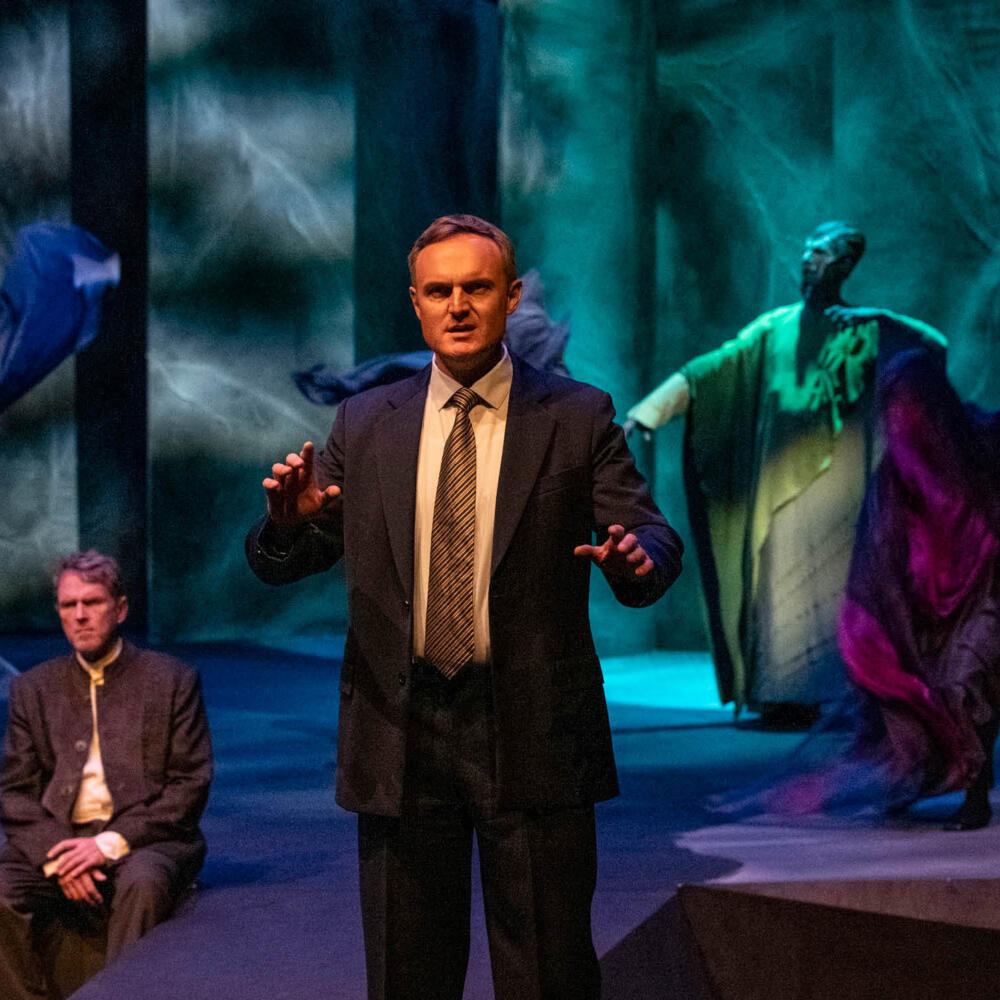
Title image Mystery Dramas 2023, from left: Christian Jaschke, Andreas Heinrich. Photo: Georg Tedeschi