
Celebrations at the first Waldorf School
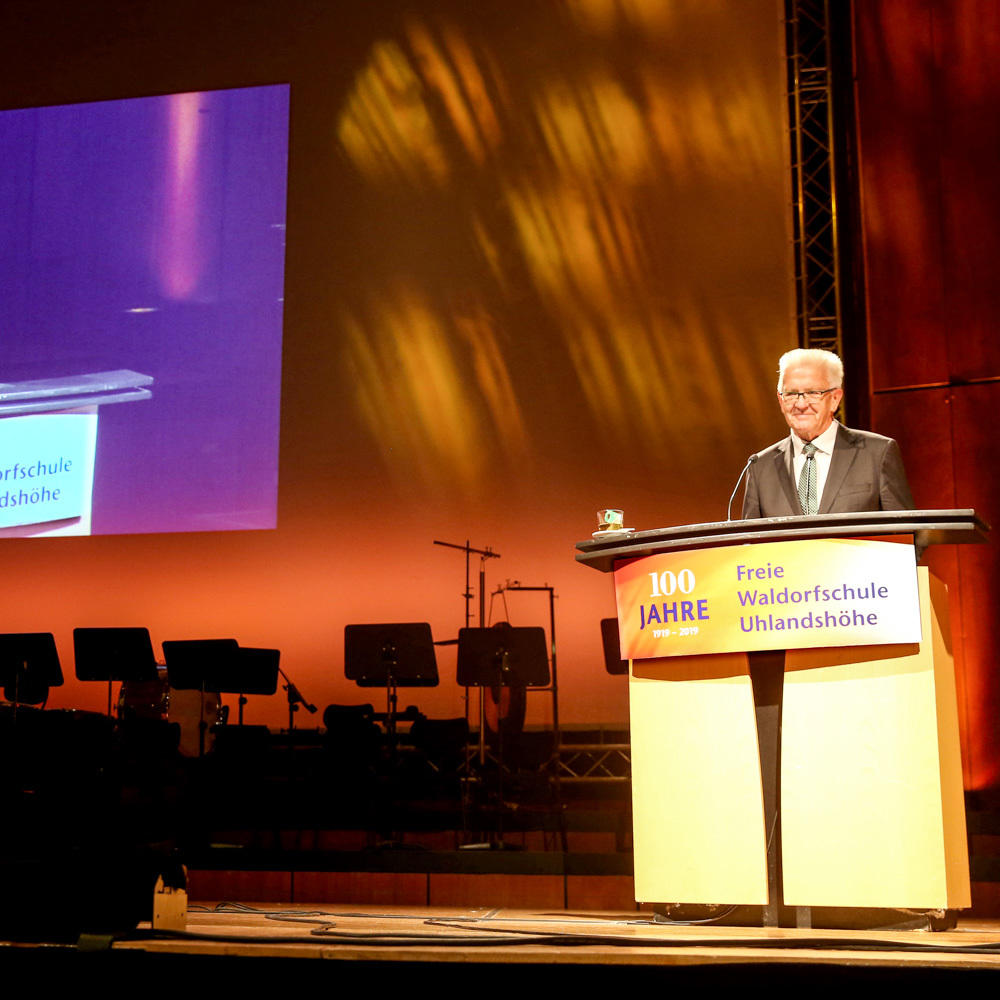
On 7 September the 100th birthday of the very first Waldorf School was celebrated festively in Stuttgart in the presence of premier Winfried Kretschmann.
What an occasion! The venue was the Liederhalle in Stuttgart, with prominent politicians and representatives of the Waldorf world present, a packed auditorium and a rich and diverse programme: the 100th birthday of the Stuttgart Uhlandshöhe Waldorf School was celebrated in style. It started with an orchestral piece by Sebastian Bartmann followed by words of welcome spoken by pupils of the school in 24 languages. Baden-Wurttemberg’s premier Winfried Kretschmann expressed the wish that the Waldorf School may retain its own identity and lauded its «strong sense of empathy», while Stuttgart’s mayor Fritz Kuhn hoped that it may continue to be the «yeast in the reform dough of the state school system». Other speakers included representatives from the Uhlandshöhe Waldorf School, the teacher training seminar Freie Hochschule Stuttgart, the Education Section at the Goetheanum and the Association of Waldorf Schools. One of the central statements was that an independent development of individuals and society needs independent schools that are not influenced by political and economic interests. An interesting bit of background information: the politicians and Henning Kullak-Ublick, who is on the board of the Association of Waldorf Schools (de), were among the founders of the German Green Party and studied Rudolf Steiner’s ideas of social threefolding.
A Japanese drummer ensemble and a Namibian school choir brought life to the auditorium, followed by a mammoth school festival with artistic presentations from pupils of all the Stuttgart Waldorf Schools and a panel discussion that concluded with a special request: may the school implement its ideals even more radically in practice because the problems in the world are enormous and there is so much to do.
Source Erziehungskunst 11/2019 (extracts)