
Eurythmy in Faust
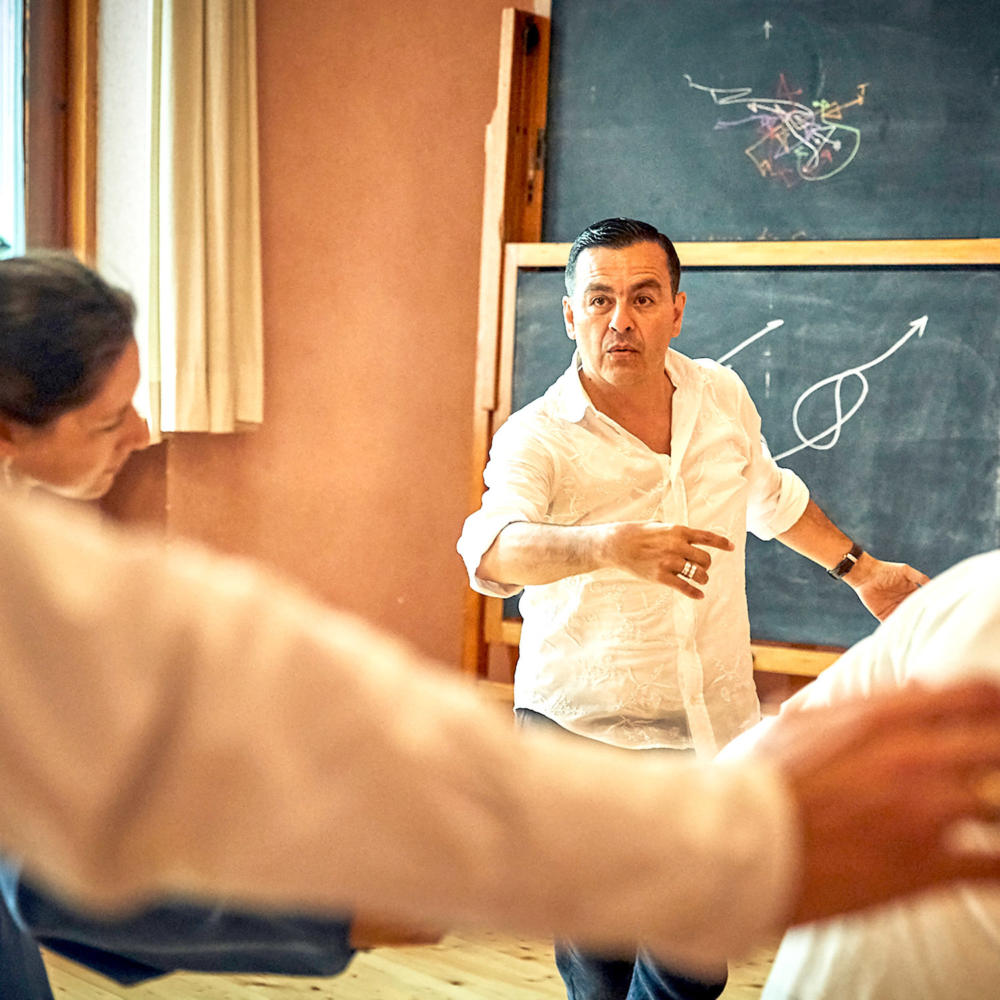
Eurythmy has a specific role to play in the new production of Goethe’s Faust 1&2 at the Goetheanum (director: Andrea Pfaehler).
Tremendous things happen in Faust: Faust, the scholar, calls on beings that he turns out not to be equal to, he grows younger after drinking a magic potion and he gets to know worlds whose inhabitants are sometimes caught in permanence and sometimes in constant change. “Eurythmy shows the in-between and takes us to a place where we can sense what lives behind the things, waiting to be discovered,” says Eduardo Torres, who is responsible for the eurythmy in this new production of Faust 1&2. “It touches on the mystery of life”.
Andrea Pfaehler, the director of this production, adds that in her view “our way of life is more like that of Faust’s assistant Wagner than that of Faust. We take our cue from the past, prefer to follow examples, hardly think for ourselves and are reluctant to embark on something new.” The latter was particularly important, however, especially when traditional ways and views can no longer carry us. “In Faust, Goethe shows me where I myself can really become creator,” says Eduardo Torres.
Not everything is smooth and pleasant on this path. “Wagner does science without the spirit – his creation needs Mephisto’s help. Wagner, moreover, stays behind in the laboratory while the Homunculus is keen to evolve,” Andrea Pfaehler points out. Eurythmy offers a director more than the possibility to “present metaphysical beings.” It allows the distinction between how an angel moves or an archangel, an earth spirit or a devil. “Eurythmy touches something in us that we would otherwise not experience: the question as to the source from which a being draws.
Web www.faust.jetzt