
Developing and deepening key competence
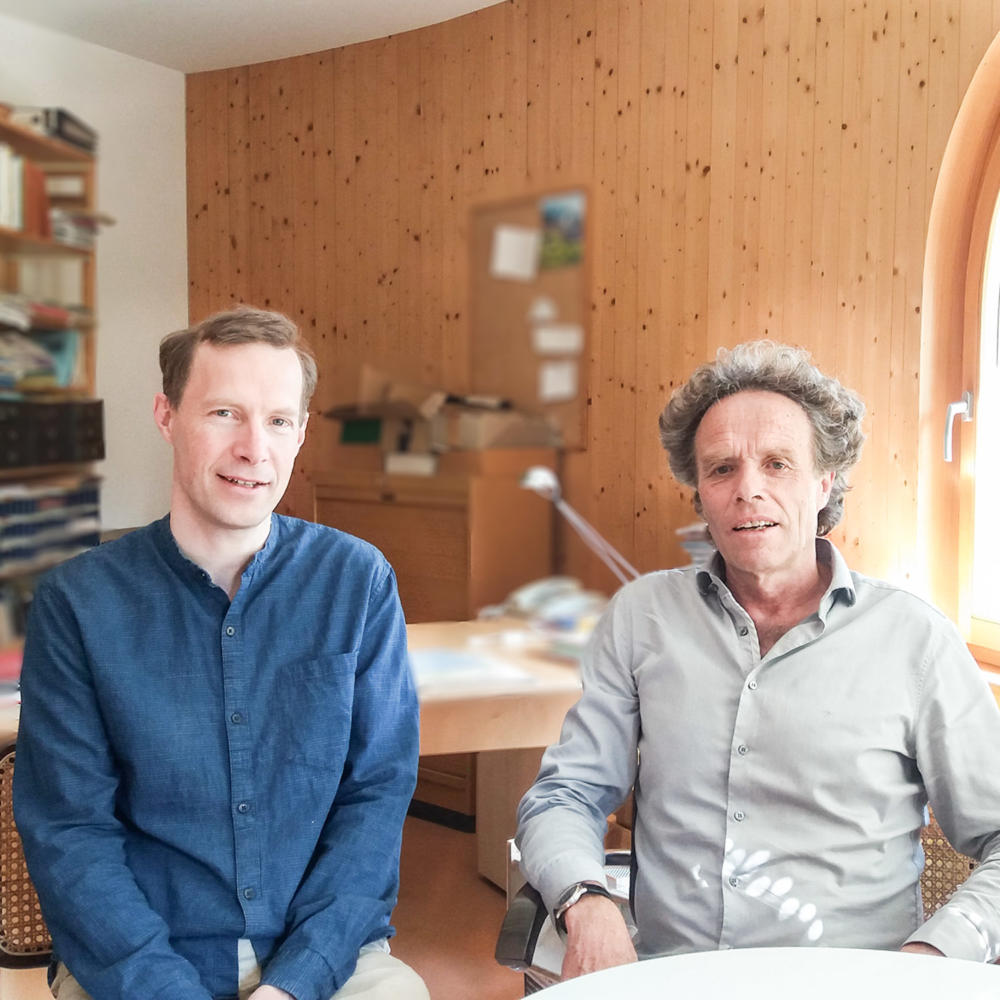
At the beginning of the year Matthias Rang and Johannes Wirz took on the leadership of the Natural Science Section at the Goetheanum. The physicist and the biologist, both committed scientists, are networking with colleagues and also concerned with the social implications of their particular professional fields.
Sebastian Jüngel Johannes Wirz, your research topics include genetics, bees and the socio-political question of “Seeds as a Commons” – which is also the title of a publication you co-authored. How do you bring these different topics together?
Johannes Wirz What these topics have in common is that the question as to the ‘whole’ and as to their relationship with the social sphere lives in all of them. Genetics is central to the development of all living creatures, including humans, but it is not their origin. If we see genetic substance as text interpreted by plants, animals and humans, we come quite close to Goethe’s typology and the idea of human individuality.
The bees are my love story. Thanks to Rudolf Steiner we are able to discover in the bees images for a future human coexistence.
In collaboration with Ueli Hurter and Peter Kunz, and based on the achievements of Elinor Ostrom, the first woman to win the Nobel Prize in economics, we have worked on the question that humanity is responsible for the emergence of a huge diversity of cultural plants and that this human commons will be lost if it is not withdrawn from the rules governing profit-oriented private property.
The human self-image
Jüngel Matthias Rang, your interest in optics is reflected in your dissertation and in exhibitions you organized. What inspires your living interest in the theory and practice of physics?
Matthias Rang Following my dissertation, in which I tried to unite Goethe’s Theory of Colours with modern optics, and in addition to my scientific publications, I feel the need to give something back to the Society that has funded this research. This I have done, for instance, by creating, with the artist Nora Löbe, the exhibition “Experience Colour”, which was shown in various countries.
Jüngel Where is research with regard to question of free will?
Rang In a project we are working on with the neurologist Siegward Elsas we are applying a Goethean principle: instead of inferring general validity from the conclusions derived from an experiment, as is usually the case, we try to conduct many experiments and derive an understanding from them. One of the challenges we face is how to process the abundance of experimental data on the basis of good scientific criteria. On the other hand, the question is so important for our human self-image that the results are not only interesting for our colleagues.
Academic connections
Jüngel Do you have contact with other scientists and researchers?
Wirz We are convinced that Goethean-anthroposophical natural science will end up as no more than a historical footnote, if it does not keep in touch with modern academic science. This is why we are keen to share our views within the academic context. We have fostered this contact for some time, for instance when we organized the international Ifgene Conference back in 1996 that brought around 200 scientists from all over the world to the Goetheanum. It was important to us then, as it is now, that the dialogue is conducted on equal terms – unpatronizingly – and that our contributions can be understood. In such encounters we always come across rigid thinkers, inflexible representatives of academic materialism, but we also meet those who work in a Goethean way, even if they don’t call it that, and who apply holistic research methods.
Jüngel How important is Goethean-anthroposophical natural science in that context?
Wirz No sphere of life can be without natural science, whether we look at climate questions, medicine, pharmacy or technology. We have a certain obligation here which we can only fulfil if we continue to develop and deepen our key competence. For this we need local research projects. The Section could not survive without this ‘metabolic pole’! At the same time, we are very happy that we have colleagues who work with Goethean research methods in the same direction, in many other countries.
Rang If we imagine the School of Spiritual Science as an organism, the Natural Science Section could be compared to its feet. For Rudolf Steiner it was important to build anthroposophy on the foundations of modern natural science, while his studies of Goethe’s natural science formed the cradle in which the seeds of anthroposophy could unfold. We think that every generation has to acquire its own new foundation.
Being more present as a Section
Jüngel What are your plans?
Wirz We are planning a project on fish which would complete the work that has been done on the idea of threefoldness in mammals, birds, amphibians and insects. We have just started a project in cooperation with the Kwalis Research Institute which applies natural-scientific expertise directly to testing food quality. This project could be extended further in future by involving the Section for Agriculture and the Medical Section. But first we have to raise the necessary funds.
Rang We are presently celebrating many centenaries in the anthroposophical movement – whilst also experiencing many attacks on anthroposophy and its fields of application. Many of these attacks are underpinned with scientific arguments.
People have gained a certainty of knowledge in the natural sciences that rests on limiting the validity of a statement. However, many of the attacks on anthroposophy use scientific statements without considering their limitations. This does not necessarily apply to the scientists themselves, but among some parts of society science has become a ‘pseudo religion’. Interestingly, it is these circles in particular who accuse us of religious tendencies. In this respect, we feel called upon to strengthen our presence as a Section.
Website of the Natural Science Section.