
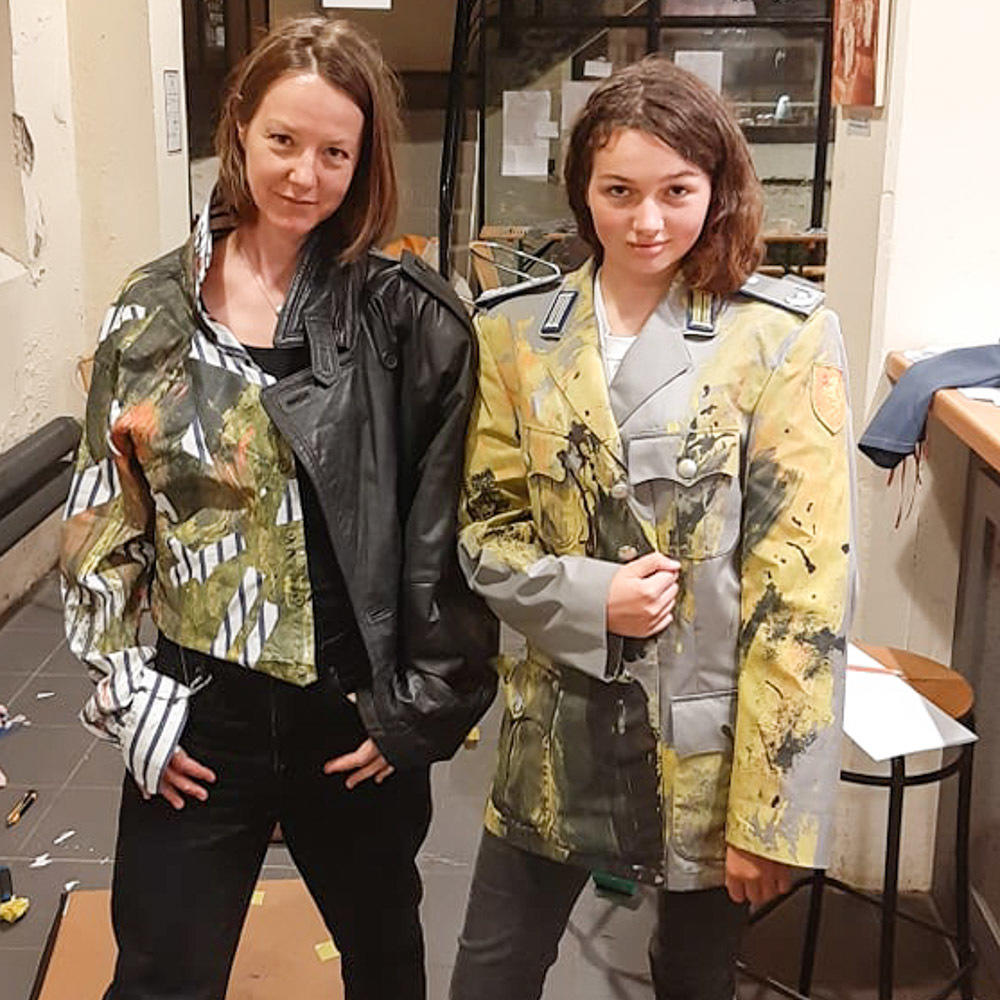
Fashion design with Eva Gronbach
After attending the Waldorf School and passing her Abitur at a secondary school in Bonn (DE) Eva Gronbach trained as a dressmaker in Düsseldorf (DE) before studying fashion design in Brussels (BE) and Paris (FR).
She designed uniforms for Thalys and Novotel, worked for Yohji Yamamoto and Stephen Jones, designed the official fan shirts for the 2006 Football World Cup and creates her own collections. Her active involvement with Waldorf 100 took her to the Friends of Rudolf Steiner’s Education where the idea for the photobook «Insights Worldwide – 100 Years of Waldorf Education» was conceived. Kehrer Publishing (DE) has published the book in collaboration with Leica.
Working in fashion brings up questions of identity, belonging and demarcation: Who am I? How do I become conscious of that? Who do I want to belong to? Who do I want to dissociate myself from?
It is therefore not surprising that young people in particular speak out when it comes to fashion – everyone has a right to their own new departures, especially at this time of life. Another advantage of fashion is that it is concrete and tangible. It allows for communication across language barriers, for instance in classrooms with refugees.
The story behind our clothes
As part of the project Being Fashion Conscious I ask young people to reflect on their clothes. They describe what they wear and where they get it from, maybe even what they paid for it. Occasionally we also talk about what they don’t wear. One refugee spoke about a jacket his mother gave him to take along, a jacket with many pockets. On his journey it got caught on a border fence and, because he had to run, he left it behind. As he talked about this we realized how much of a story a jacket can tell, even to us who hadn’t even seen it.
Or I ask them to bring in a piece of clothing from home. Often the young people bring in something special, something that has some significance within their family: a mirror dress from Afghanistan, a colourful African print dress, an Indian sari or a Bavarian «dirndl». This task often sets off a certain dynamic because the family now asks questions like: Where do I come from? Memories come up – one talks together and shares experiences.
Close to the fabric
The next step is to ask: Where are you going? The young people begin to draw pieces of clothing. They don’t need instructions – they can all draw! I merely encourage them not to copy other people’s designs or existing labels.
The drawings and designs are then pinned up and we look at them together. This confronts them with the idea before they enter into the production process. The next step is the execution, the sewing. They usually need help with this, for instance advice on how the fabric needs to be treated, how one best irons and sews it. In my experience sewing by hand is more immediate than using a sewing machine: applying stitch after stitch, very close to the fabric. This also creates interaction, for often the mothers, grandmothers, or even the fathers join in and help.
After three to four days it is done: the pieces of clothing – all of them unique – can be tried on: an immediate experience of success. For the young people it is also important that they can present their work to an audience. It motivates them; they become more critical and make more of an effort.
In my experience the young people hardly judge each other; it is more that they are surprised at each other’s achievement. This creates respect. They see how each one has their strength. This is about acceptance: How do I meet myself? How do I meet others? One gets better at reading ‹codes› others are using. This makes young people more independent; they emancipate themselves from many things that used to influence them to a greater or lesser extent.
Meditating on clothes
We can all think about the clothes we wear, where they come from, as in one of Rudolf Steiner’s subsidiary exercises: where were they produced? Under what working conditions? How are they sewn? From what fabrics? We can also reflect on our attitude to shopping and how we feel when we put on a piece of clothing and what it is like when we make changes to it. Finally, we can also imagine what effect what we wear has on others. Then it can happen that a previously anonymous piece of clothing begins to belong to us (particularly, of course, if we’ve made it ourselves).
Web: www.evagronbach.com