
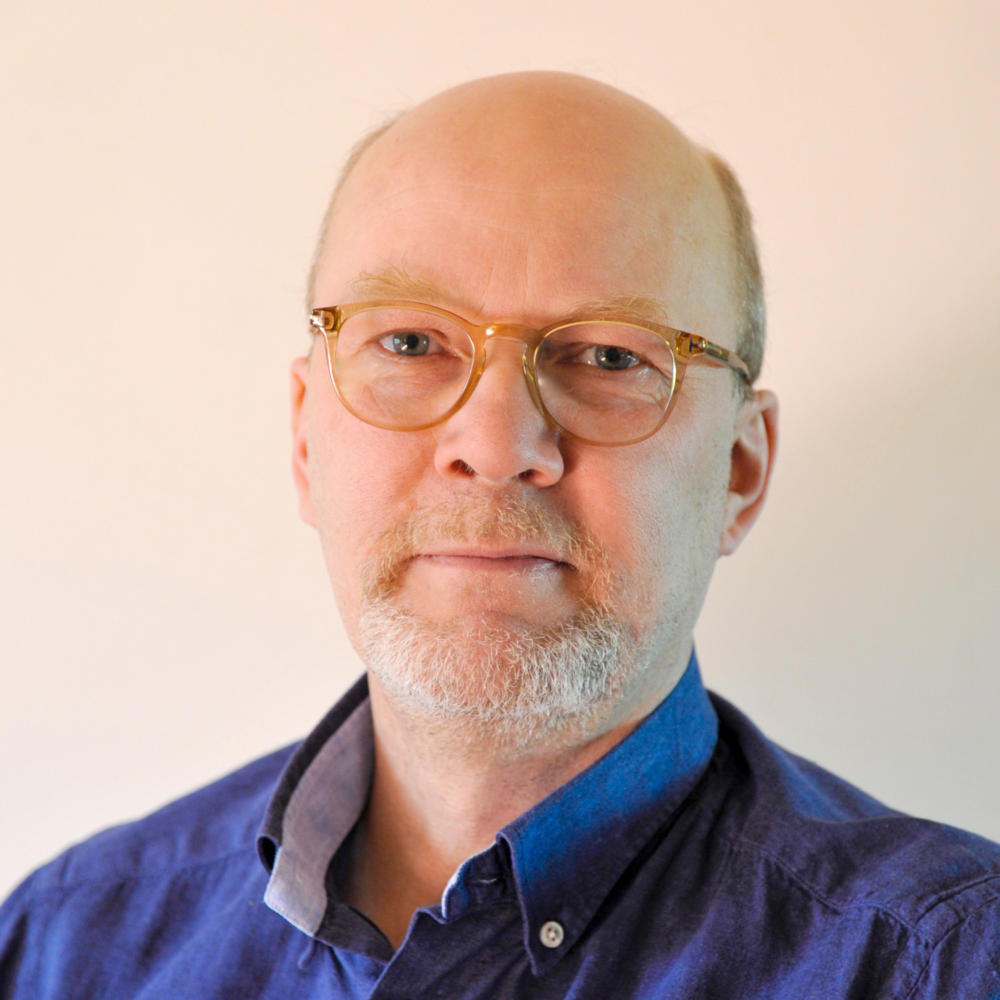
New representative Janne Silvasti
Janne Silvasti is an artist, colourist, lazurer, class and art teacher. Born and raised in Tampere (FI), he spent some time in the Saar region of Germany before moving to Järna (SE), where he has been for almost thirty years now. He joined the Council of the Anthroposophical Society in Sweden in 2014 and was made country representative in September 2020.
Sebastian Jüngel Sweden is currently much talked of because of its approach to the Corona pandemic: while it is for some a country that respects the freedom of its people, others see it as an example of the failure of this kind of liberal attitude. What do people in Sweden feel like?
Janne Silvasti Sweden is a freedom-loving country. People have confidence in the authorities. The relatively relaxed way of dealing with the pandemic in Sweden has worked well so far, with the exception of the shortcomings in elderly care, which were initially overlooked when the virus was spread by staff whose knowledge and equipment were insufficient. Too many elderly people lost their lives.
Kindergartens and schools have remained open. The Swedes are optimists! They like to discuss and practise new and creative ways of living together and they have a strong will to not give up and to look for new solutions.
Flexible, curious, open
Jüngel People associate certain images with Sweden. Are they part of its inner make-up? What influences these associations?
Silvasti Sweden looks back on a long, rich and exciting history: the Vikings, for instance, or the kings of the period of great power, or the political figures who entered the world stage later. The country’s history is echoed in current events such as the awarding of the Nobel Prize that draws the world’s attention to Sweden every year. You need to bear in mind that Sweden has not had a war in 200 years! People here have a deeply rooted sense of safety.
We also have an open society that quickly absorbs new trends without forgetting its roots. Sweden is known for its community spirit. Certain social structures are firmly embedded in all layers of society. ‘Fika’ (enjoying coffee and cake together at work) is a must in everyday life. The Swedish folk soul is flexible, curious and open; it seeks closeness to and dependence on others, without being necessarily interested in their opinions.
The world is interested in how Sweden deals with social issues and why it is that these generally well educated people often come up with all kinds of innovations. The young music coming out of Sweden is world class; Greta Thunberg’s unusual fight for the environment has inspired her entire generation.
Presenting alternatives
Jüngel What can anthroposophy build on spiritually in Sweden? And what can anthroposophy bring to Sweden that is new?
Silvasti For many young Swedes the idea of reincarnation is not alien. But people here don’t like to speak about beliefs and world views. It’s more under the surface; but there is interest, as well as resistance!
Certain topics, such as the artist Hilma af Klint (1862-1944), who was inspired by anthroposophy and who is much talked about again today, awaken a global interest in Sweden and in the anthroposophical view of the world. Sweden’s anthroposophical centre in Ytterjärna, just outside of Järna, started as a Scandinavian initiative. Anthroposophy has presented Swedish society with alternatives for more than sixty years: schools, healthcare, environmentally friendly products and much more.
Sweden differs from its neighbour, Norway, in one respect: we don’t have well-known anthroposophists appearing in the media, in the public debate or political discourse. There is a wish for anthroposophy to be communal and down-to-earth. The Anthroposophical Society and its Council will continue to work on basic questions and try to be prepared for the needs and questions of the public.
Self-assured and cooperative
Jüngel What is important for you personally as the Swedish representative?
Silvasti I have a wide range of interests within anthroposophy, from the image of the human being and world evolution to the spiritual in the arts. I am convinced that the anthroposophical movement will be self-assured and cooperative as it develops along with the rest of the world, and that it will be ready to meet the challenges that come towards it.
Jüngel In a way, you have painted a picture of Sweden for us. Which colours would you choose if you wanted to express its character in an actual painting?
Silvasti The colour that would go well with Sweden does not exist; but with some imagination one could find a good one: lemon blue is the colour for Sweden!.