
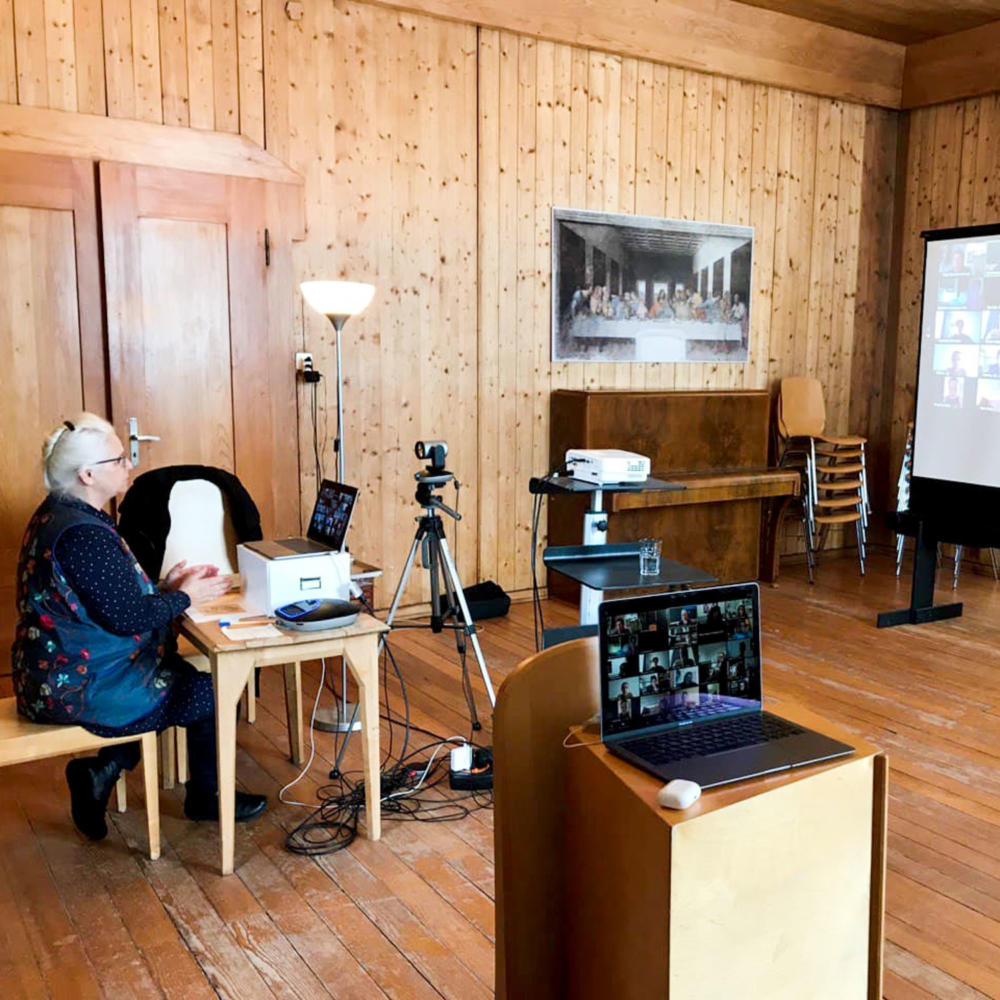
Online course
The online course offered daily throughout February by the Goetheanum’s Study and Professional Development department was attended by 63 people from 31 countries.
Sebastian Jüngel What, if any, changes did you have to make to adapt your programme to the online format?
Edda Nehmiz The content remains the same but the teaching methods need changing and the times need to be adapted. We offer the online course for people whose situation is informed by lockdown and additional challenges. Finding a source of strength within oneself, such as connecting with a thought, creating an inner space through art, focussing on the present and making new contacts can be invigorating experiences. When life challenges us, outer form, precision and rhythm can help us direct our forces towards the content.
Connecting
Jüngel Have you changed the presentation?
Nehmiz In-person presentations live from the fact that a thought is presented in its entirety and then brought to a conclusion. With the digital format, this makes people tired sooner. This format is more suited to presenting a larger extract out of the whole and then involving everyone in bringing it to a conclusion.
In our experience, presentations or introductions to artistic activities should not exceed 20 minutes; conversations should be restricted to 75 minutes. Colloquia are possible with larger groups whereas study groups should not have more than 25 persons, so one still has an overview on the screen. Moderating plays an important part in digital events to ensure that everyone feels included.
We are making use of all the possibilities the digital format offers, including break-out rooms, screen sharing, videos, documents and chat. But we also include elements from in-person teaching such as blackboards because this provides a link to previous learning experiences.
A particularly vibrant experience is the live tour of the Goetheanum, where we use a smartphone attached to a selfie stick. It gives the impression that one is shown around the Goetheanum by a friend, and it allows participants to interactively connect with the Goetheanum or discover something new about it.
Jüngel What can you say about newly recruited participants?
Nehmiz We have mostly reached people who cannot really get to the Goetheanum, even if there is no pandemic. Because everyone is in their own home during the course, their individual cultural mood is much more present – and yet, one meets and is united across all the boundaries of culture and mentality.
The Goetheanum is in reach
Jüngel What next?
Nehmiz We have been able to improvise and open up a space of vitality and encounter. We will therefore offer the course again in May/June. In the long term, we will need better technical equipment. It also needs to be considered with hybrid events (in-person and digital), that we not only need the technology but also people in the background who are in charge and people who are available for questions and answers, ideally live.
Jüngel What new possibilities have opened up for you?
Nehmiz The digital space is not an alternative, nor is it a stopgap; it is additional. It has become a space that – as any other space – unfolds in accordance with the underlying intentions and that holds great potential. Over and above that, it offers the Goetheanum the chance to reach people who would otherwise hardly ever get to it, Coronavirus or not. This means that the Goetheanum becomes a reality for people, as a place of knowledge, encounter and experience, where one can meet in thoughts, artistic activity, conversation without losing out compared to in-person meetings.