
Studies on the lessons of the first class of the School of Spiritual Science
Research in the General Anthroposophical Section at the Goetheanum, in as much as it relates to the inner path of development in the first class of the Michael School, focuses mainly on four major topics and questions.
(1) Deepening the understanding of Rudolf Steiner’s intentions in establishing the first class. (2) Style, form, composition and mantric content of the lessons held by Rudolf Steiner himself. (3) Ita Wegman’s continued work with the class lessons after Rudolf Steiner’s death. (4) The relationship of the class lessons with general anthroposophy, the Karma Lectures and the Leading Thoughts.
The intentions of the first class of the Michael School
Study of the documents has revealed that Rudolf Steiner started the class lessons three weeks later than planned because his intentions had not been rightly understood before that.[1] His intention was not to offer esoteric lessons for people with a special interest in such topics, or even for the spiritually ‘advanced’. He wanted to found a community that would take responsibility for an effective anthroposophy, a school that would represent anthroposophy, a study course that would prepare participants through inner training for taking on responsibility. The necessary conditions for becoming a member of the School were defined by Rudolf Steiner as sufficient knowledge of anthroposophy, affirmation through membership of the Anthroposophical Society as the entity carrying the School as well as the personal decision to be a representative.
The class lessons for members of the School of Spiritual Science were certainly not ‘secret’ but were held during all the major events of the Anthroposophical Society that took place after the Christmas Conference of 1923/1924. They were advertised in the programmes, designated as class lessons, and Rudolf Steiner wrote about them in the Newsletters of the Anthroposophical Society.
Neither was School membership a private matter but had to do with the professional commitment to the effectiveness of anthroposophy in the different spheres of life. Rudolf Steiner recommended that the teachers of the Waldorf school in Stuttgart (DE), whom he viewed as representatives of anthroposophy in the field of education, become School members. In 1924 all the Christian Community priests and ‘young medics’ joined the School, as did the artists who worked at the Goetheanum and elsewhere, all the leading figures in supportive education and many of those present at the Koberwitz course about a new agriculture of the living earth.
In recent years, these developments have been studied within the General Anthroposophical Section at the Goetheanum Class Conference and published to highlight on their relevance today.[2]
The School of Spiritual Science Conference to be held at the Goetheanum in November 2026, which will include all class lessons in German, English, Spanish and French, is also committed to this orientation.[3] Further studies into the relationship of the specialist sections with the class lessons will follow. They will be published in the School of Spiritual Science Newsletter that is released by the General Anthroposophical Section twice yearly in five languages on behalf of the Goetheanum Leadership.[4]
Rudolf Steiner’s class lessons
The class lessons held by Rudolf Steiner constituted a new approach to esoteric teaching, although there had been an Esoteric School under his leadership as early as 1904 in the German Section of the Theosophical Society. In-depth studies are currently carried out within the Section into Rudolf Steiner’s way of holding the class lessons, which can be seen as the archetype of today’s and future lessons.
Rudolf Steiner did not read Mass. The lessons he held were lessons in spirit-presence that breathed freedom and they included the blackboard drawings and notes he created during the lessons. He did not merely develop references to the mantric essence of the lessons but a new form of lived and taught spirituality. The lessons were vibrant events that could be deeply experienced by everyone present. The chorus of the spiritual hierarchies, the words of the Guardian of the Threshold and of the human beings called upon resounded in a shared Michaelic space that connected everyone in it.
The current studies aim to provide a clearer picture of Rudolf Steiner’s special approach and its model character.
In 1992, the Rudolf Steiner estate administration (Nachlassverwaltung) published all the surviving preliminary manuscripts for the mantras. It is essential in this context to earnestly consider these and to experience the process of the evolving mantric words in thought and meditation. The short-hand notes reflect the ultimate form of the class lessons. To experience their process of becoming can open up ways of approaching the spiritual content that are informed by spirit presence and openness to the future.[5]
Ita Wegman’s continuation of the esoteric work
Although Rudolf Steiner pointed out in all the class lessons from September 1924 that Ita Wegman was co-responsible for the lessons and their mantric essence, her special task in connection with the ‘Esoteric School of the Goetheanum’ remained unrecognized for many decades.[6] Little or nothing was known either about her attempts to continue the lessons after Rudolf Steiner’s death as the person co-responsible for the first class, not only in Dornach, Switzerland, but as early as 1925 in European capitals such as Paris (France), The Hague (Netherlands), Vienna (Austria), Prague (Czechoslovakia) and London (Great Britain) as well as other German cities.
On the occasion of Ita Wegman’s 150th birthday on 22 February 2026, these activities and the motifs that guided them were for the first time researched in detail and published within the General Anthroposophical Section / Ita Wegman Institute,[7] including her collaboration with regional class holders whose work had started in Rudolf Steiner’s lifetime with his support.[8]
Ita Wegman’s initiative to continue the class work after 30 March 1925 is important, particularly in relation to the specialized professional fields. She made sure that Rudolf Steiner’s intentions would live on in the professional working communities, particularly in medicine, supportive education and education. The spiritually oriented communities were facing tremendous external difficulties that would stretch them to the limit once the Nazis had seized power. Rudolf Steiner anticipated these challenges and referred to them often; the forces appear prominently in the class lessons.[9]
On 12 February 1933, Werner Pache, who worked with children with support needs at Schloss Hamborn in Germany, wrote to Ita Wegman: ‘We would like to ask again if you could possibly travel via Hamborn on your way back from England and hold a class lesson here. As I stood on Wittenberg Square in Berlin the night before last, where, as in many other public places, Hitler’s speech boomed out over loudspeakers and the power of Ahriman was almost overwhelming, I suddenly felt a calm confidence so strong that I was all at once detached from this evil power. I felt that our cause will not perish.’[10]
Class lessons and general anthroposophy
The lessons of the first class of the School of Spiritual Science constitute a true treasure that will very probably become more widespread in the coming decades and centuries. The whole of anthroposophy streamed into and culminated in these lessons. Multiple studies are therefore needed to explore in greater depth the general anthroposophical motifs and ideas underlying the class lessons, a type of research that only grew more autonomous and dynamic in the twenty-first century.[11] In the years to come the existing attempts must be deepened and continued in dialogue with Rudolf Steiner’s complete works.
The Leadership of the General Anthroposophical Section at the Goetheanum has embarked on a three-year process working, among other things, on the convergence of the class lessons, the Karma Lectures and Rudolf Steiner’s Leading Thoughts – the three great general anthroposophical contributions that emerged after the Christmas Conference of 1923/1924. A special bilingual (German/English) edition released by the Section explores the intentions and structure of Rudolf Steiner’s Leading Thoughts. It came out on the hundredth anniversary of Rudolf Steiner’s death as a study edition involving three international anthroposophical publishers. A special volume with the Karma Lectures is envisaged as a comprehensive, chronological study edition with annotations and commentary that will also consider the motifs and themes of the simultaneously held class lessons and the Leading Thoughts.
In this way the leadership of the General Anthroposophical Section in collaboration with many School members tries to do justice to some of the tasks set by Rudolf Steiner. The written elaborations are an original task of the School but not an end unto themselves. Their purpose is rather to promote the developmental processes enabled by the Michael School – as the spiritual core shared by all the sections – and to benefit the work in the diverse fields.
Notes
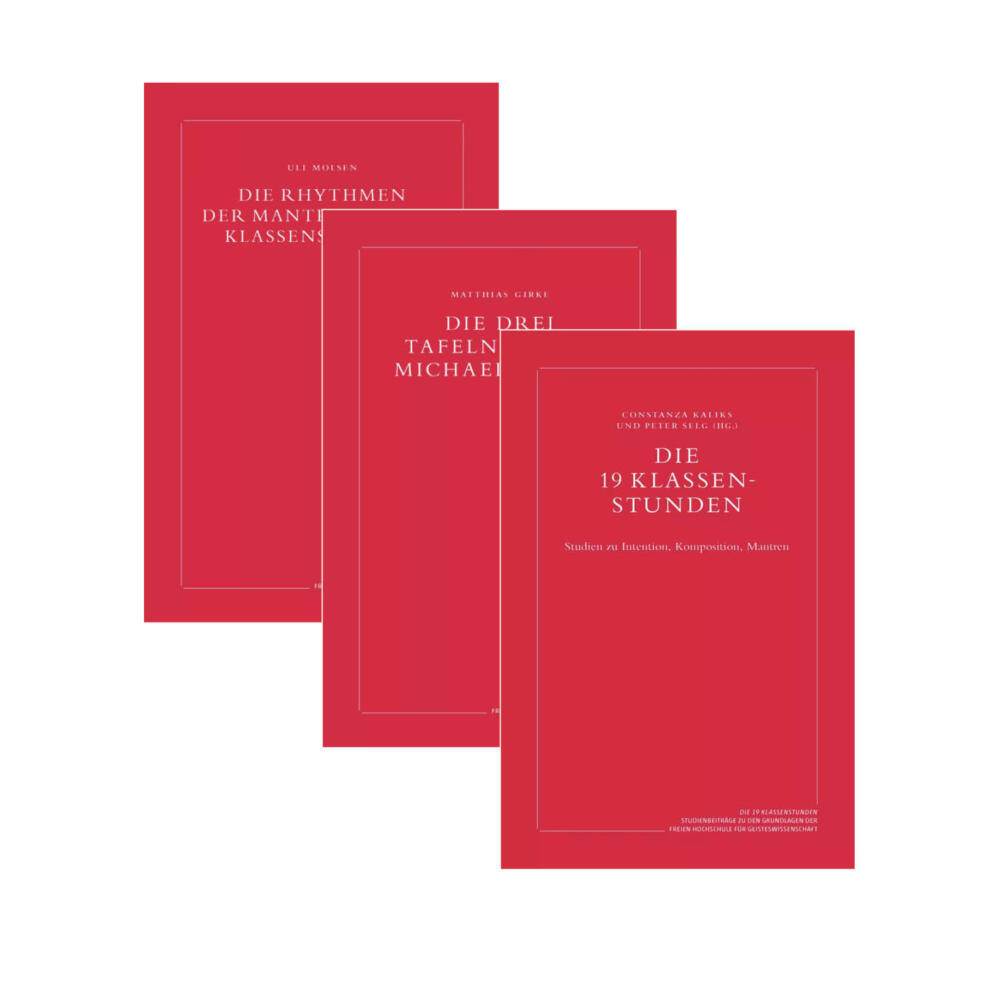
1 Cf. Constanza Kaliks / Peter Selg (eds): Die 19 Klassenstunden. Studien zu Intention, Komposition, Mantren, 2025, p. 56ff.
2 For instance Peter Selg: The Anthroposophical World Society and Its School for Spiritual Science, SteinerBooks 2024, trans. M. and D. Miller
3 General Anthroposophical Section
4 Subscription to free newsletter at schoolmembership@goetheanum.ch
5 Peter Selg: Rudolf Steiner hält Klassenstunden. Vom Werden des mantrischen Wortes. Aufsätze zur Ersten Klasse (in print)
6 Rudolf Steiner: Esoterische Unterweisungen für die erste Klasse der Freien Hochschule für Geisteswissenschaft am Goetheanum (GA 270), 2020, p. 282. Available in English as: Esoteric Lessons of the First Class of the School of Spiritual Science at the Goetheanum, Dornach 2020
7 Peter Selg: Die Zukunft der Hochschule. Briefe und Aufsätze Ita Wegman, April – Dezember 1925, 2026
8 Johannes Kiersch: Die Entwicklung der Freien Hochschule für Geisteswissenschaft. Die Erste Klasse, 2005, p. 91ff. Available in English as A History of the School of Spiritual Science. The First Class, Temple Lodge Publishing 2006, trans. Anna R. Meuss
9 Peter Selg: Facing Evil and the Guardian Speaks. Esoteric Lessons of the First Class. SteinerBooks 2024, trans. Jeff Martin
10 Ita Wegman Archives, Arlesheim (Switzerland)
11 Cf. Peter Selg: Rudolf Steiner and the School for Spiritual Science. The Foundation of the First Class. SteinerBooks 2012, trans. Margot M. Saar; Sergei O. Prokofieff: The First Class of the Michael School and its Christological Foundations. Philosophisch-Anthroposophischer Verlag am Goetheanum 2009; Peter Selg: The Michael School and the School for Spiritual Science, SteinerBooks 2016, trans. Matthew Barton; Sergei O. Prokofieff: The Esoteric Path Through the Nineteen Class Lessons in the Light of the Supersensible Mystery of Golgotha and the Fifth Gospel. Philosophisch-Anthroposophischer Verlag am Goetheanum 2016.