
Taught on tablet
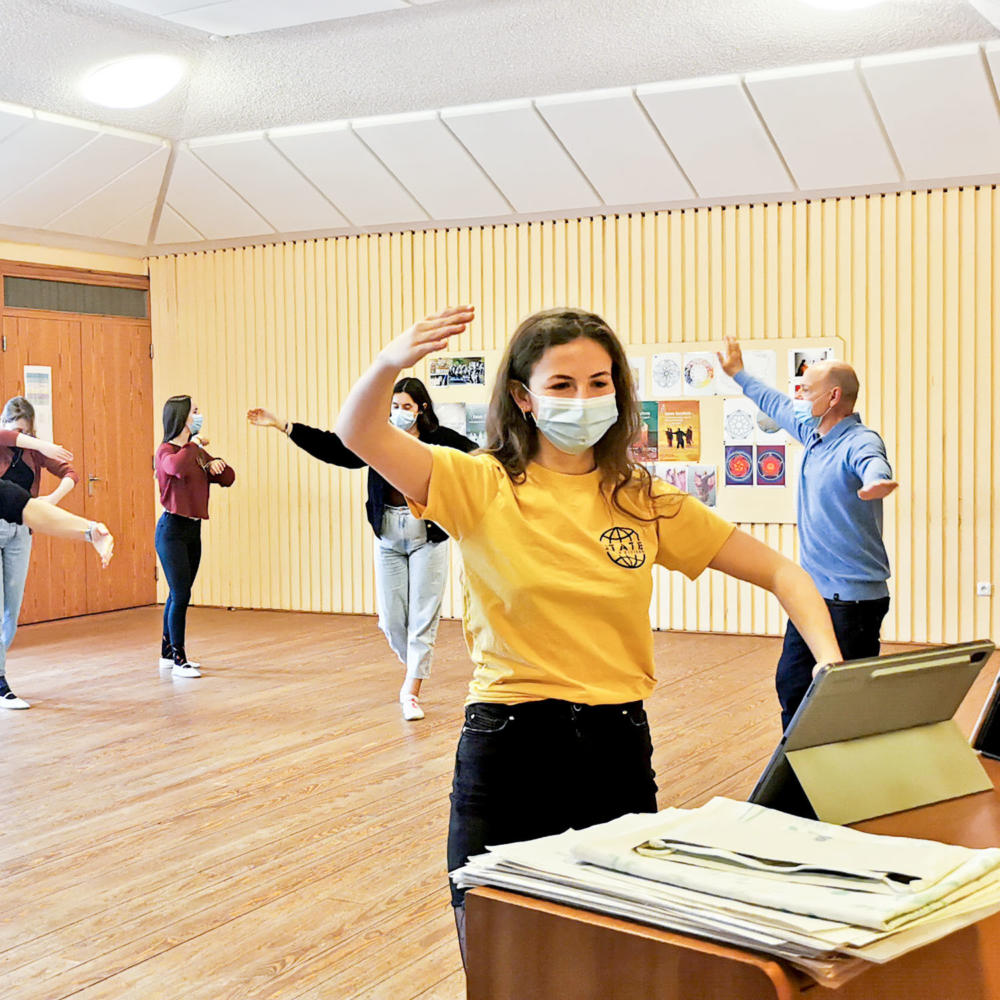
At the Rudolf Steiner School in Hamburg-Bergstedt, students participated in eurythmy lessons on their tablet. Jürgen Frank was open to the experience.
An early morning in November, 8 o’clock, class 13’s main lesson has been moved. As I go through the register I realize that two students are absent. But then one of them appears in the doorway, clutching a tablet. Did I know that NN was self-isolating because they had a Covid case in the family? Would I mind if she took part in the lesson - on her tablet?
I agree, somewhat amused. And there she is: joining us virtually, on the screen: all bright-eyed and bushy-tailed. No, she was not sick, it was another member of her family, but she had to stay at home for two weeks! I’m not sure what seems more peculiar to me: that I look into this private room or that she is the first upper school student I have seen in many, many weeks who is not wearing a face mask?
From the windowsill to the piano
We are finding a place for the tablet. Then we calmly repeat the different positions of our starting exercise ‘I think speech’, that need polishing again and again. The students are in pairs, facing each other and correcting one another in a friendly but clear manner – a process we have practised for a long time. I stand in front of the tablet, which is on the windowsill, and work with the student at home. This initially strange (to put it mildly) process is saved by the student, however, who is open and concentrated.
After this exercise, the tablet – the student, as it were – is moved onto the piano so that she has a better view of the next part of the lesson.
We are working on the forms and sounds of a poem by Nelly Sachs. I give them most of the sounds for the first lines. The idea is in this case that I give them the first sounds, pointing the way and then leave them gradually to work independently.
Simply copying the teacher’s movements can, of course, only be part of the whole exercise, and the actual work of the students begins as they fill these movements inwardly and bring them to expression outwardly, and above all, as they act independently.
Now and again I cast a glance towards the piano and see my student deeply engaged in forming the sounds.
At the end of the lesson we all say good-bye to her and express our wish that she may soon be able to come back to school.
We continued this in the next three lessons and it became ever more natural. It was astonishing how quickly one can adjust to such a situation, even accepting it as ‘normal’.
Integrated in the group choreography
But there was more to come, because a second student had to self-isolate at home. She also joined us online. Now we had two tablets on the piano – with two young women taking part intensively in the lessons from home.
On that evening I pictured a nightmare: I was standing in my eurythmy room, surrounded by many screens, each of them with a student. A horror image! That I did not have to wear a face covering in that dream or constantly air the room was only small consolation.
What I found astonishing was that both students, once they returned to school, mastered all the gestures we had practised while they were away. Even better: they had no problem joining into the choreography we had worked out for fifteen students.
Source ‹Auftakt› Nr. 1/2021 (edited)
Web Steinerschule Bergstedt