
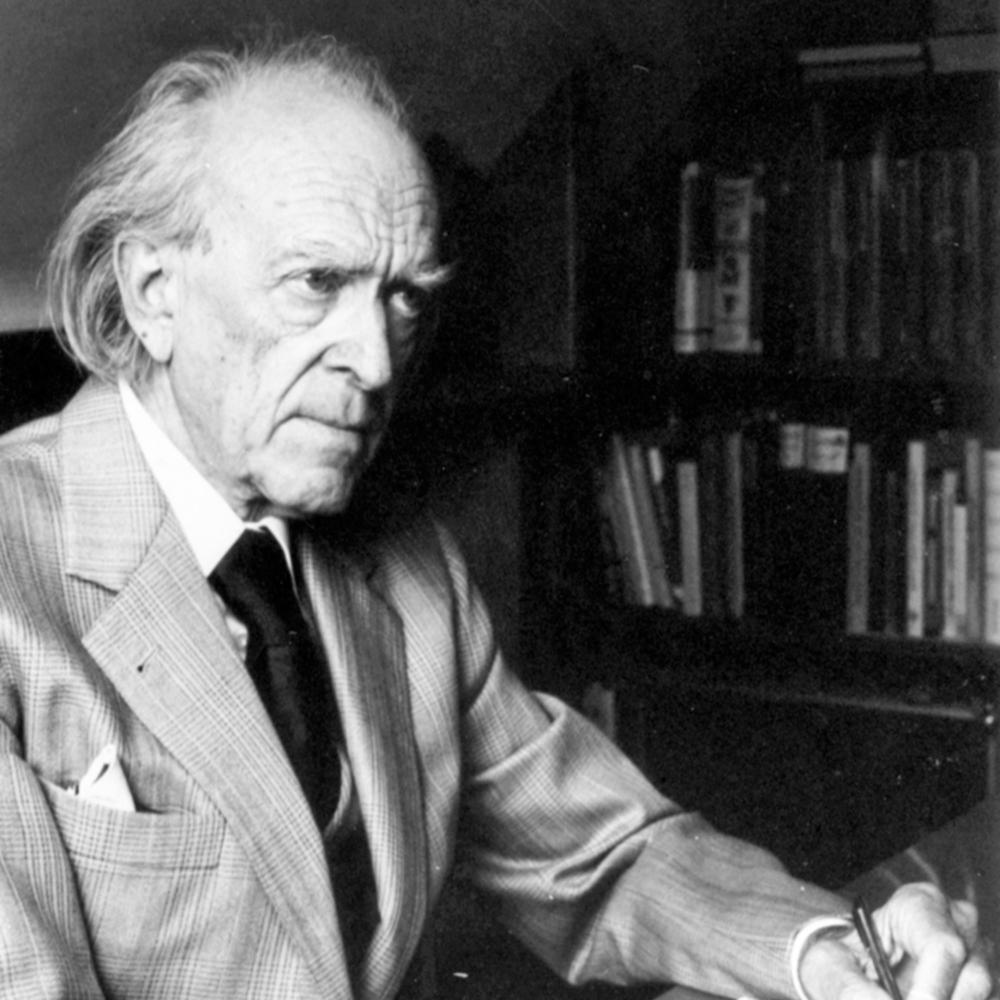
Concern: Herbert Witzenmann rehabilitation
In 1935 Ita Wegman and Elisabeth Vreede were removed from office by the General Meeting and a large number of members were excluded from the Anthroposophical Society.
Thirty-three years later, on 14 January 1968, the then Executive Council one-sidedly announced its ‹book resolution› in the anthroposophical newsletter (Nachrichtenblatt 7/1968). Herbert Witzenmann, who was a member of the Executive Council at the time, was the only opposing this decision.
The term «book resolution» refers to the decision to sell the books of what was then called the Nachlassverein – the administration of Rudolf Steiner’s literary estate (today Rudolf Steiner Verlag) – at the Goetheanum, although the Annual General Meeting of 1956 had decided against this with 1153 over 47 votes.
Under Albert Steffen’s leadership it had been assumed that books edited by the Nachlassverein, which did not accept the spiritual continuity of the 1923/1924 Christmas Conference, could not be sold at the Goetheanum without gravely violating the modern mysteries’ principle of truthfulness.
Amfortas’ wound
In my view, Herbert Witzenmann saw this violation as an Amfortas wound inflicted on the spiritual being Anthroposophia, a wound that would have serious consequences. This fact found expression in the publication of Rudolf Steiner’s work. The intentions expressed by Rudolf Steiner during the Christmas Conference as regards the printing of his collected works (cf. Article 8 of the Founding Statutes) were not put into practice. Herbert Witzenmann was concerned that Rudolf Steiner’s work would end up unprotected. Is this an old, dusty episode in the history of the Anthroposophical Society that has become entirely irrelevant today?
Herbert Witzenmann
Herbert Witzenmann (1905–1988) was a factory owner, patented inventor, economist, poet and pianist, scientist, author of numerous essays and books and a member of the Executive Council at the Goetheanum. He was uncompromising in his belief that Rudolf Steiner’s work needed protecting, and it still needs protecting today. His epistemological work shows that he knew how to permeate his spiritually sophisticated writings and lectures with the kind of inner substance that protects them from intellectual and sentimental exploitation.
The historical background
Herbert Witzenmann devoted his entire life to individualized intuition and observation. With his spiritual farsightedness he realized that the «book resolution» would remove the protection that Rudolf Steiner’s work needed. «The 14 of January 1968 had a negative impact on world history!» (Herbert Witzenmann). The problem that remains tied up with the ‹book question› concerns the spiritual continuity and continued effect Rudolf Steiner has had on his pupils and on the world today, although he is no longer physically among us.
How are we dealing with Rudolf Steiner’s work? This is the crucial question that was at the root of the conflict. Is it still relevant today? How do we protect Rudolf Steiner’s work today? Do the turmoil and polarization surrounding Christian Clement’s and Hartmut Traub’s journal Steiner Studies, for which Jost Schieren and Wolf-Ulrich Klünker are also working, not show us clearly that the question of protection is as relevant today, after 52 years, as it was in 1968? Herbert Witzenmann was gravely concerned about the forgotten protection, which we provide as little today as we did then? What is the essence of this protection?
The book resolution of 1968
Rudolf Grosse, who was chair of the Executive Council at the time, justified the ‹book resolution› by saying, «This will set free forces which can be used to further the development of the Anthroposophical Society and, particularly, to realize the School of Spiritual Science.»
The opposite was the case and a serious conflict was created within the Anthroposophical Society that lasted until 1979, when the motion that the General Meeting should remove Herbert Witzenmann from office failed because of his impressive accountability report.
In May 1970 the majority of council members decided to take the Social Science Section away from Herbert Witzenmann. On his sickbed he received a letter from his Council colleagues, which was published in the January newsletter of 1972 (Nachrichtenblatt 3/1972). The letter stated the Council’s decision to relieve Herbert Witzenmann from all his functions on both the Executive Council and in the School of Spiritual Science.
The scientific foundations of anthroposophy – our future?
Half a century later, it has become possible, with goodwill, to leave behind the old, trodden paths of the conflict and find new ways of integrating the scientific stream into the Anthroposophical Society. It is a challenging task, however, that cannot be achieved from one day to the next. It is my opinion that, when Herbert Witzenmann was exiled, the spiritual essence of the scientific anthroposophy that he was able to represent quietly fled from the Goetheanum.
I think that the future of the Anthroposophical Society depends on regaining this spiritual essence. Because the conflict makes us ask how we can deal with Rudolf Steiner’s work, how we make it our own in all its depth, so that we are able to protect it. The processing of the Society’s history that is required for the sought rehabilitation will enable us to realize the future form of the Anthroposophical Society, aside from many other tasks. Only when Spirit-Recalling, Spirit-Awareness and Spirit-Beholding unite will we be able to reshape the social reality. Herbert Witzenmann does not need personal rehabilitation, but today’s Anthroposophical Society needs it urgently.
I ask the Executive Council to prepare the rehabilitation of Herbert Witzenmann together with the members. By rehabilitation I mean the reintegration of his personality and his work into the Anthroposophical Society from which he was – factually even if not legally – excluded and exiled. This reintegration must be accompanied by the recognition of all of Herbert Witzenmann’s achievements with regard to the spiritual continuation of the Christmas Conference of 1923/1924 and the social-aesthetic impulses for a social form of the Anthroposophical Society that is suited to our time.
Fundamental reappraisal
On 4 February 2020 the Goetheanum Executive Council met with Eugen Meier and supported his concern. The situation can, however, not be resolved by a single act or decision of the General Meeting but the developments at the time including the underlying controversy about Rudolf Steiner’s literary estate and the different views on the School of Spiritual Science need to be worked through gradually in a future-oriented way. | Justus Wittich for the Executive Council at the Goetheanum