
Changed eating preferences
Catering services during Goetheanum events will change and be simplified in accordance with today’s eating habits. Another hope connected with this change is that the structural deficit can be overcome.
According to Ueli Hurter eating preferences have changed in recent years. Together with Operations Manager Rebekka Frischknecht he represents the Goetheanum in relation to the Speisehaus restaurant which is in charge of event catering.
In 2024, a concept was developed for catering at the Goetheanum which aimed to find alternatives to the traditional three-course menu that was served during events at lunchtime and in the evening. ‘We know, and our visitors confirm this, that lunch and an evening snack are sufficient now,’ Ueli Hurter points out.
After Sabine Hagg had taken over the management of the catering department and had to step down again unexpectedly for personal reasons, the opportunity was used to restructure catering at the Goetheanum, in the hope that it could also be made financially viable. The changes will not affect the Speisehaus bakery (Anthroposophy Worldwide 11/2022), which continues to grow and delivers throughout Switzerland, or the health-food shop in the Speisehaus.
Catering not covering costs
The previous catering infrastructure was designed for higher visitor numbers or broader utilization during events. ‘It has become clear in recent years that the number of operating days is not enough to cover costs,’ say Lucas and Thomas Didden, who together with Ueli Hurter, have ultimate responsibility for the Speisehaus.
‘A structural deficit cannot be the solution, nor can asking our visitors to pay more for catering,’ says Ueli Hurter, who also speaks on behalf of the Executive Council at the Goetheanum. The General Anthroposophical Society, he adds, must ultimately also contribute to the associated catering operation of the Speisehaus and cover potential losses.
The team comprising Ueli Hurter, Rebekka Frischknecht, Lucas and Thomas Didden has decided on the following changes which are due to take effect after the World Early Childhood Conference in April.
From 13 April 2026 the kitchen and restaurant in the Speisehaus will be closed. The company Peppone Catering is interested in renting the kitchen infrastructure from August onwards. Peppone Catering is managed by Oliver Hübscher who trained at the Sonnenhof in Arlesheim (CH) under Heinz Fendrich and has previously worked at the Speisehaus. The company is certified organic and uses Demeter products wherever possible. They deliver around 700 meals daily to nurseries in the region and are part of the Overall Cooperative for Integrated Working.
New concepts are currently being explored for the use of the rooms on the first floor of the Speisehaus. These could include, for example, social projects for youngsters or for older people.
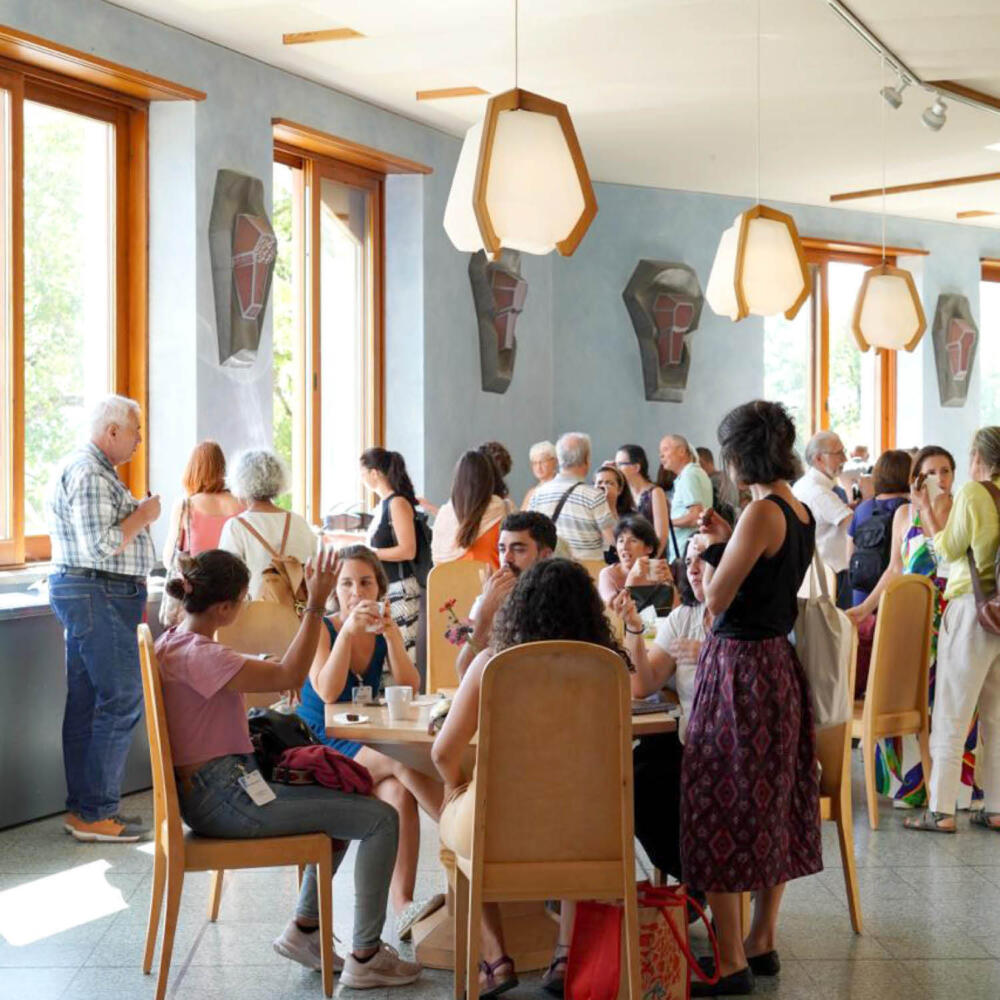
Catering in the Speisehaus as a traditional restaurant is being replaced by the cafeteria in the Goetheanum building. Rebekka Frischknecht points out that ‘the aim is to ensure a continued basic but high-quality organic catering service at the Goetheanum.’
Shorter mealtimes
The new concept is also based on the observation that, with the change of dietary needs, mealtimes have also become shorter. This means that simpler meals allow more people to be catered for in a smaller space. Catering will therefore in the future be concentrated in the cafeteria in the Goetheanum foyer. Additional seating will be available, for instance outside, if the weather permits this. Staggered mealtimes will be offered as required.
For large events with 400 guests or more, the facilities in the Schreinerei building will continue to be used as before. Catering for these events will be provided by Peppone Catering and service by the staff of the Speisehaus Gastro company.
‘We know that these changes require adjustments from everyone involved,’ says Ueli Hurter on behalf of the planning group. ‘Our aim remains to provide good and appropriate catering at the Goetheanum, to adapt it to today’s needs and, at the same time, act in a way that is economically responsible.’