
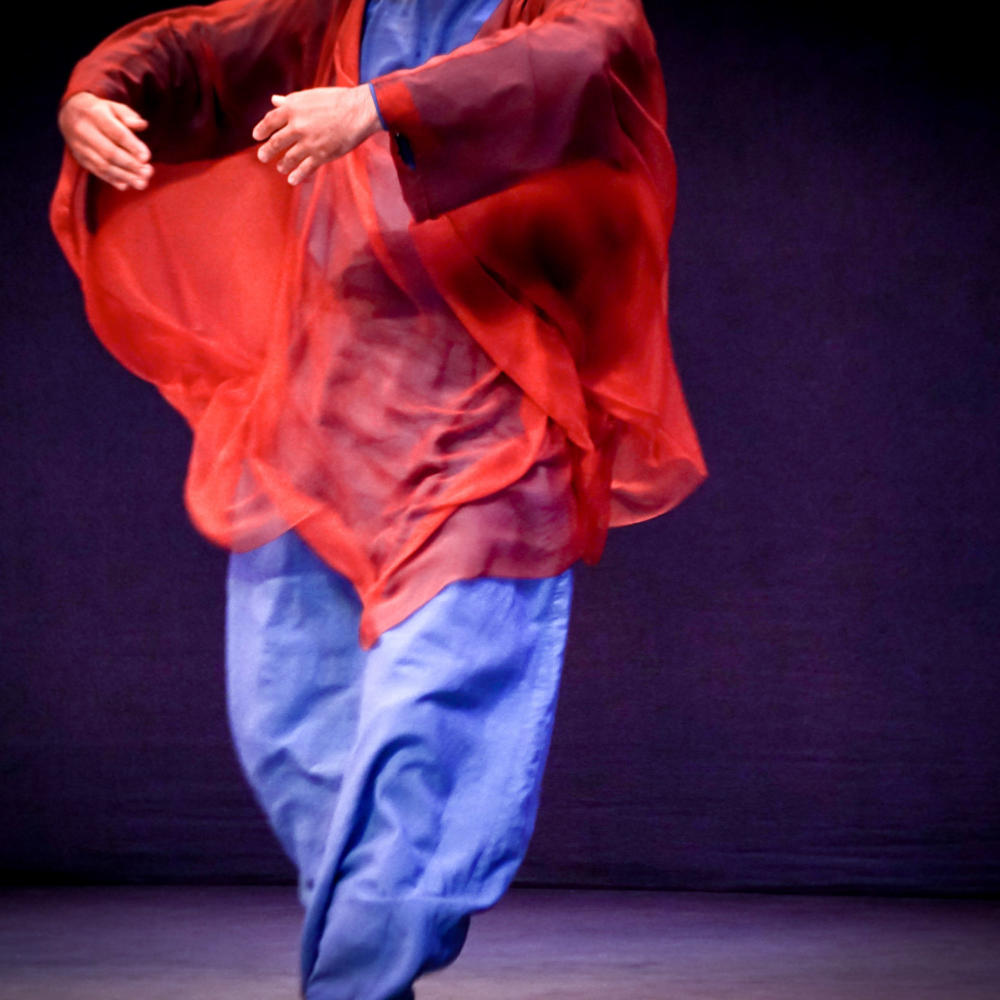
Carried along by real life
The necessity to keep a distance due to the Coronavirus pandemic has made the digital media seem like ‘saviours’: lessons, meetings, lectures and performances often take place online now. These meetings may seem almost real, but we have to learn to grasp and perceive the difference in quality between the living and the lifeless.
In the digital world, things such as tone (music), sound (speech) or colour (image) are represented numerically. Through this abstraction a ‘data package’ is put together that, in turn, can then be shown on a screen, resound through a loudspeaker and be transmitted via the internet.
The individual image that appears on the screen consists of many small points (pixels). Our sense of vision combines series of individual images into fluid movements; this is, however, an illusion of movement. The eye is our most active sense organ but when we look at a screen, the eye becomes physiologically passive: it has nothing to do.
With loudspeakers, too, we have a breaking up – in this case of acoustic vibrations – into individual components. Our sense of hearing reassembles these components, giving the impression that we perceive a whole. However advanced the technology, technical devices cannot generate a warm, airy sound. People with sensitive hearing experience this fragmentation.
Strong and radiant but without aperiphery
The forces of the cosmos radiate towards the earth’s centre. This creates a periphery. Everything alive participates in this etheric periphery. Everything that lives has a periphery; the lifeless does not.
In eurythmy, the physical human body becomes the instrument of the etheric, making visible the invisible movements that make the ether body vibrate, in speech and music for instance. Eurythmy can have a healing effect on a sick organism by guiding it to its original lawfulness. The subtle perception of one’s own self, of others and of human interactions can have a healing effect on society.
As part of an experiment, eurythmy exercises were shown on stage and then projected onto a screen. There, the colours appear as strong and radiant, the contours more pronounced. We also notice that we are not carried along. We focus towards the front and remain in our own space – there is no-one to meet; the transmission does not generate a periphery. Music from a loudspeaker can awake wonderful feelings in us but, again, the peripheral impression is missing. Digital, or virtual, reality has a centring, sucking, contracting effect. Real life, on the other hand, carries us along; we share the same periphery, where there is active warmth and the space in the back is also included. Here, we are not only aware of the actions but also of what is carried into the space, even into the world, through them.
Learning to deal with the etheric
A robot cannot do eurythmy because it is unable to generate a periphery – it does not take part in the etheric. The ability to become aware of such things may well be crucial for humanity’s further evolution. Particularly because it will become ever more difficult, as technology progresses, to be aware – with corresponding training – of the difference between what is alive and what is lifeless.
We should be enthusiastic about discovering and developing creative artistic forms, so that eurythmy can be conveyed in a way that helps us learn to include the etheric even when real encounters are not possible. There must be hundreds of ideas and possibilities for exercises that don’t involve staring at devices and merely imitating what we see there.
Laura Rojas Palacio, born in Cali (CO) in 1992, will complete her studies at the Eurythmeum CH in 2021. She wrote her diploma thesis on the topic ‘From the living to the lifeless. Eurythmy online’.
Rudolf Steiner on singing and speech
The element of warmth enters into the stream of singing or sound. The ‘I’ lives in this warmth element. This is how singing and speech gain their inwardness. The tone’s or sound’s true soul comes into being because this warmth flows over the air waves that form the tone outwardly. The astral body is active in the flowing air itself while the ‘I’ is present in the warmth that pours over the waves of air. Usually, the astral body and the ‘I’ are not only present in the air and warmth, but also in the fluid and solid elements of the human body; when we speak or sing, however, they partially withdraw from there and restrict themselves to air and warmth.
Source: Rudolf Steiner, GA 278, lecture of 20 February 1923.