
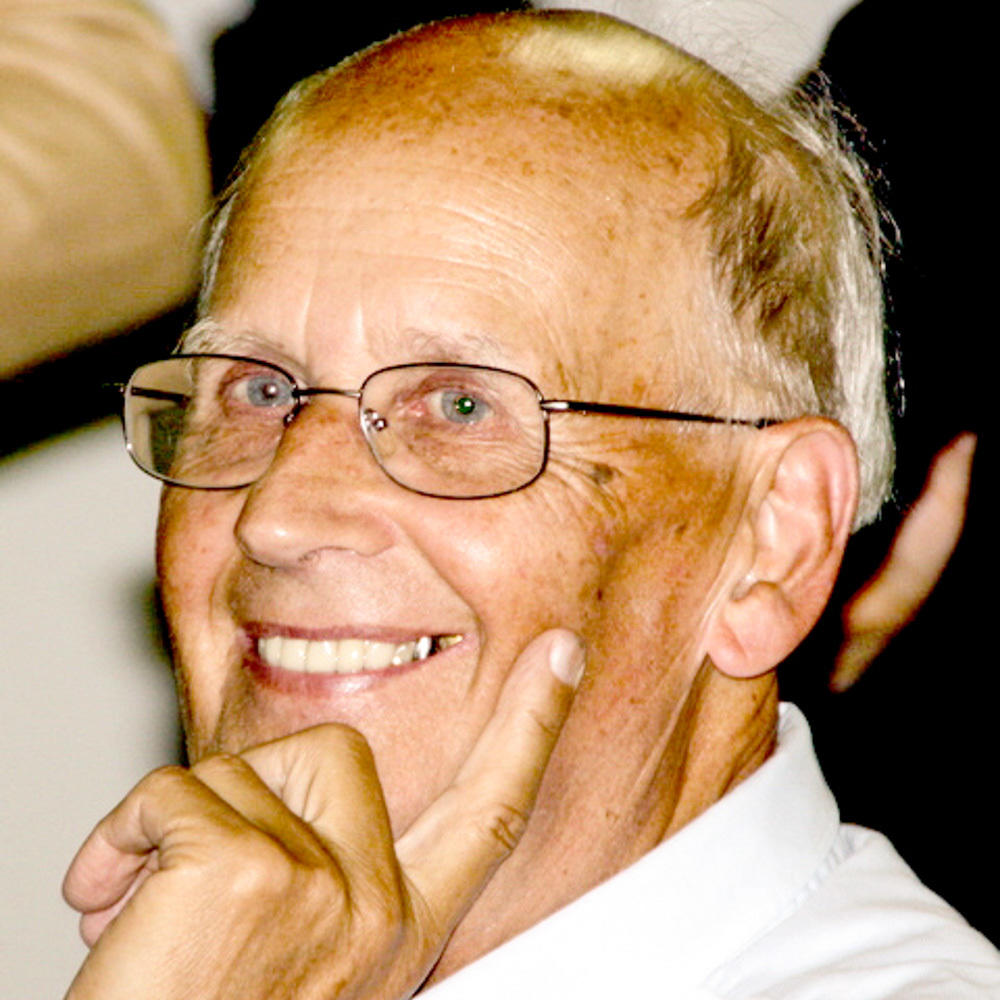
Hartmut Haupt
Hartmut Haupt’s life was devoted to art, science and religion: highly musical, with perfect pitch, he first studied physics and then attended the priest seminary before finding his way back to music.
Devoted organist
Hartmut Haupt, the fifth child of musical parents, was born in Bonn (DE) in 1932. His great love for the organ was awakened by Johann Sebastian Bach’s D minor Toccata and Fugue. When the family moved to Jena (DE) he developed an interest in astronomy and meteorology and began to study these subjects in 1950. When this interest failed to find fulfilment he changed to physics, a subject in which he went on to gain his doctorate.
Through his first marriage he met anthroposophy which, in the GDR could only exist under the umbrella of the Christian Community. This was a turning point in his life. He gave in his notice at Jenapharm, the pharmaceutical company he worked for, in order to attend the Christian Community’s Priest Seminary. Shortly before graduating, the by then head of a family returned to Jenapharm.
In all those years he never stopped fostering his love for music, often sitting at the organ at 5.30 in the morning, before going to work. For one year he was organist at the St Michael Church in Jena.
In 1967 he married Bärbel Klauder and became a father again. Unusually for the GDR, Hartmut Haupt became self-employed in 1975 in monument preservation and as an organist. He inspected many organs in Thuringia and wholeheartedly supported their restoration, saving many instruments from oblivion. The CDs he made were a further contribution to the cultural life in Thuringia. Even in GDR times, he travelled to Switzerland, Russia and the United States. His musical home was the new organ he had been instrumental in acquiring for the Volkshaus, a concert and conference venue in Jena. With 4800 pipes it is the biggest concert organ in Thuringia. Cultivating and interpreting the music of Max Reger and of his teacher Hans Georg Burkhart, was also important to him.
Hartmut Haupt led an anthroposophical reading group and later became a Class holder in Jena. He and the priest Hartwig Knabe invited the Goetheanum Stage in 1988 to perform the second Mystery Drama in Jena. With the help of locally trained speech artists five performances took place with a total of 600 audience members from across Eastern Germany.
After the political changes of 1989 the Anthroposophical Society was no longer banned. Hartmut Haupt contacted the then leader of the Section for the Performing Arts at the Goetheanum, Virginia Sease. She visited him – and the organs in Thuringia. As a result of this connection he was consulted on questions regarding the organ in the Goetheanum’s main auditorium. He would play many concerts there.
Social engagement
Hartmut Haupt was socially active on behalf of a child aid organization in Jena and supported the founding of a community hospital. He represented the Anthroposophical Society and cause courageously in public.
Until his death he played on his Bechstein grand piano which was tuned to 432 Hz.
Elke Jakobeit, the priest of the Christian Community in Jena, said of Hartmut Haupt’s final days, «In the end he himself was like a tone that slowly faded to a pianissimo but, in fading, grew more intensive.»
Sources Barbara Haupt, Elke Jacobeit, Michael Kurtz, Virginia Sease, the newspaper Ost-Thüringer Zeitung of 5 June 2019