
Heart of hearts
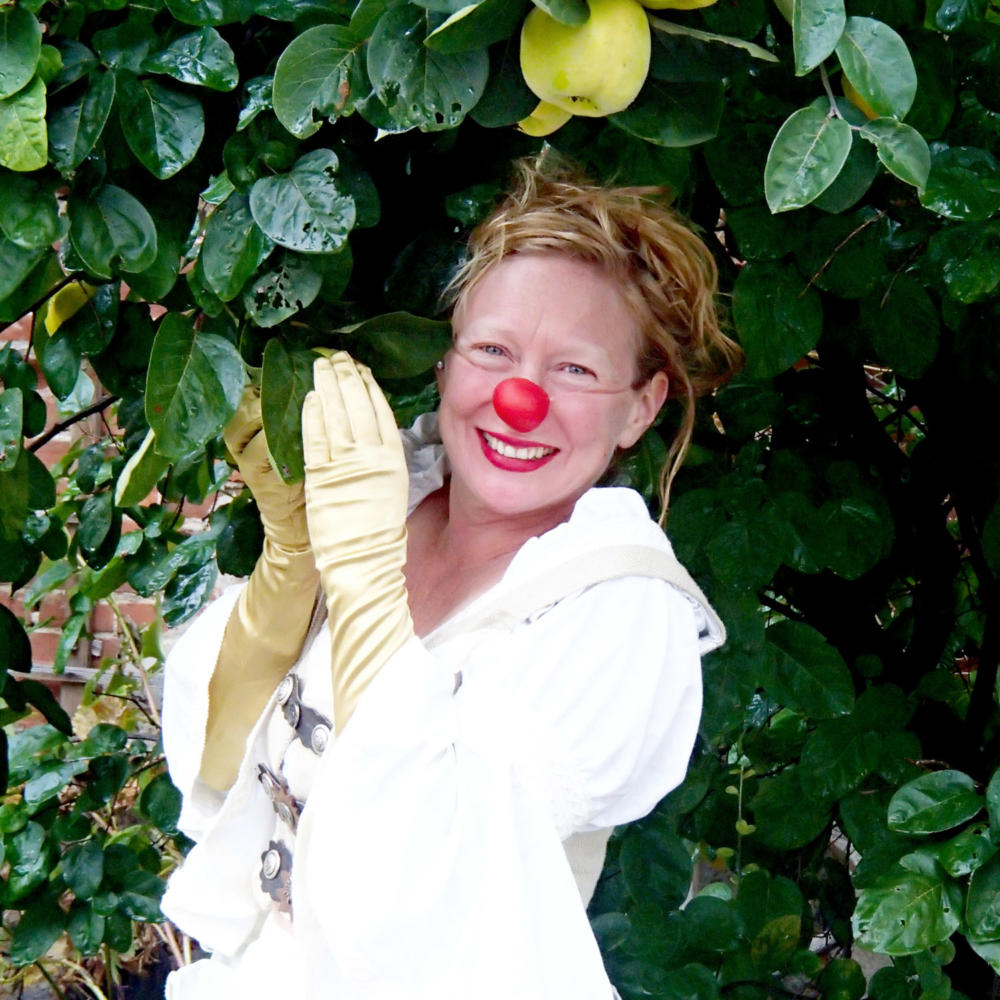
For some decades now there have been professional clowns in anthroposophical institutions and Waldorf schools, too. The Section for the Performing Arts at the Goetheanum is exploring who is working as a clown or is interested in clowning. Catherine Bryden, who trained with Nose to Nose (GB), is one of the active clowns.
I was first touched by the clown Geist in high school during improvisation and theater workshops with a Canadian director, Robert Lepage. His approach to a creative path is one of deep openheartedness. He created safe fun spaces for teenagers to be as much themselves as possible. After that I studied theater and developmental psychology at university, while running summer theater and language camps based on similar qualities learned from Robert Lepage, in particular curiosity and fun.
Round red door
In 2001, when I landed in Germany at the Rudolf Steiner Schule Gröbenzell, outside of Munich, I was mentored by another beam of artistic light, Kirsi Talvela. She said that I might find my doorway into the anthroposophical world or not. I did. Since I did not speak German, I attended as many anthroposophical training courses and workshops as possible in English.
This opened my door: it was round and red, and opened up a world of heartfelt freedom and continual discovery. After doing the whole series of courses offered by Vivian Gladwell, founder of Nose to Nose, I trained as a facilitator and transitioned from teaching English and running the grade 9 farming project to full time clowning. I have been well guided and supported on this path: from Vivian Gladwell and courses at Emerson College (gb), to Norman Skillen and Peter Lutzker’s PhD research on the influence of clowning on the personality development of teachers, to participants in workshops and cooperation with students from the various teacher training seminars.
It does not matter if I am working in the field of clown & conflict, clown & teacher, clown & trauma, storytelling, social circus or dance, the clown changes me. The changes are tangible. After being touched by the clown, we walk away clearly lighter and brighter, with greater permission to be our unique selves.
Catherine Bryden, Ering (DE)
___________________________________________________
Sebastian Jüngel When you meet someone, what image of the clown do you meet?
Catherine Bryden Since we do not build character clowns, I wait to see what sides of a person’s clown decide to present themselves in a particular moment. We leave room for any side of a person’s clown to show up.
Reconnecting with our individual purpose
SJ If this someone were an anthroposophist, how would you explain why a clown is important for anthroposophy?
CB I prefer to have people find this out through direct experience and personal discovery. That said, I would say that the clown serves to reconnect us to our deep longings, our individual purpose, our ‘true I’ in the presence of others. We embrace all that we are and all we are becoming in surprising ways.
SJ Would you agree with a statement by Clown Dimitri who writes about developing from the “clown in me to the clown through me”? This reminds me of the famous Pauline words “Not I, but the Christ in me” (Galatians 2:20). Of the archangel Michael we know that he affirms the world – an attitude a clown should have: dealing with obstacles in a positive way. Is the clown a fairly central aspect of being human?
CB Absolutely. When we are clowning, we step into the state of clown or wake up our clown. The warm-ups we do support dropping out of our heads and into our heart of hearts, opening up a space of not knowing, a space where deepest intentions and intuitions are dormant, waiting to see conscious light. When we clown, we unlearn. We remember that we are artists.
Opening up space for the future
SJ What do you see as the clown's task?
CB Awakening. Enlivening. Rejuvenating. Healing. Connecting. Opening up space for the future, the unknown.
SJ Can performers lead a daily life without the attitude of a clown?
CB When people start clowning regularly, they feel as though the world around them opens up in ways that they hadn’t previously seen. Clowning is a practice of being true to ourselves, remembering our deep aches, choosing to consciously observe and above all reserve judgement or set answers. The more people clown, the more they are able to tap into their feelings, turn to them as guides, but not be controlled by their emotions.
SJ In your opinion, should a clown wear a red nose? Why?
CB The red nose, the smallest mask in the world as Jacques Lecoq named it, carries a particular magic. I experience the world in new ways and others experience other aspects of my ‘Self’ when I am wearing a red nose. It feels as if I am wearing my heart on my face; when I look out at the world with a nose on, I feel exposed, vulnerable, and protected.
SJ Learning to become a clown is often transferred to other areas of life, for instance as a method for developing creativity or for management (body language): doesn’t this mean that the clown is used for something he or she should not be used for?
CB I think the clown can serve people in many ways. I think that the clown serves where service is needed.
Contact: catherinebryden@playisseriousbusiness.info
Web: Nose to Nose
Call: Clowns, show up!
Please contact Sebastian Jüngel at Sebastian.juengel@goetheanum.ch stating your name, (email) address, training and activity. Sebastian is compiling a list on behalf of Stefan Hasler, head of the Section for Performing Arts at the Goetheanum.