
New ways of cooperating
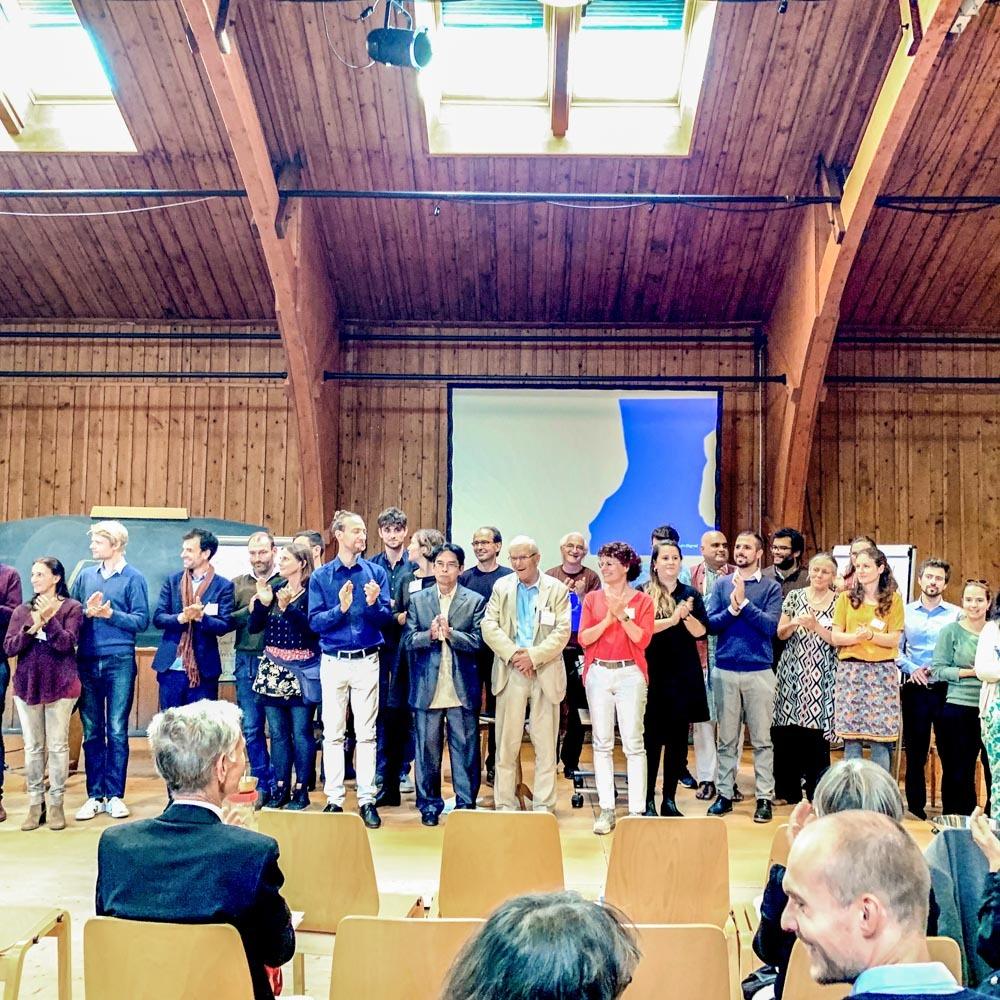
On 27 and 28 the second World Goetheanum Forum was held on new forms of cooperation. 210 people – entrepreneur and heads of institutions or initiatives – attended. A live crowdfunding event that took place as part of the Forum raised 65,000 Euros.
In 2006, Jos de Blok founded an organization for neighbourhood care (Buurtzorg) in the Netherlands that by now employs 11,000 nursing professionals. The founder – who is himself a nurse with experience in management and leadership – advocates the abolition of unnecessary administrative superstructures in favour of teams of self-determined professionals who can focus on their actual jobs. Buurtzorg consistently reduces documentation and bureaucracy to an absolute minimum, while creative and individual solutions for the good of the patients are their main concern. The network for home care also solves the problem of finding new staff. Many other countries are interested in the model.
In harmony and conflict
Hanspeter Niggli and Niklaus Schär (and others) from CoOpera make sure that pension money can become effective in the real economy. If one considers that up to 90 per cent of the global speculative exchange transactions use pension and insurance moneys, one can imagine what it means that CoOpera with its 7000 pension fund members has withdrawn 810 million Swiss Francs (or one per mille of the total pension fund money in Switzerland) from such speculation in order to let it flow into valuable economic impulses.
For Ha Vinh To meditation stands at the beginning of any successful cooperation. He is presently mostly active in Vietnam, working on the Happy Schools project from which 25 million children and adolescents in Vietnam will be benefitting in a few years’ time. The pilot project in Hue Province trains teachers, using a curriculum that focuses on the pupils’ mental and personal development. Waldorf Education and Buddhist spirituality are the sources behind this project.
Stefan Hasler, head of Performing Arts at the Goetheanum, invited the Forum participants to engage in exercises exploring the field of tension of I – You – We, as a way of experiencing encounter in harmony and conflict and honing our ability to meet in cooperative situations.
Industrial ruins as compost for new growth
Aonghus Gordon, the founder of Ruskin Mill, sees industrial ruins as compost from which something new can grow. He awakened an old glass factory to new life, giving young people with learning and behavioural disorders the opportunity to become active in ways that allow them to learn to accept themselves and others, develop craft skills and discover the quality of beauty. The Ruskin Mill Trust is planning to found its own university. The trust goes back to the initiative and spirituality of its founder, his practical-artistic and entrepreneurial competence and courage in dealing with the authorities that finance the Trust’s projects.
Aline Haldemann, Bettina Holenstein and Susanne Huber are co-leaders of Demeter Switzerland. They ‹live› the associative cooperation of producers, trade, and customers in practice and have, for instance, achieved the objective that newly hatched male chicks are no longer killed. In recent years, Demeter Switzerland has had successful negotiations with supermarket chains such as Migros and Coop.
In view of the burning ecological, social, economic and political crisis situations in the world, Gerald Häfner, head of Social Sciences at the Goetheanum, sees the need for developing and putting into practice new and ever more conscious forms of cooperation.
Giving away project funds
Armin Steuernagel, an energetic and active co-worker of the Forum and member of the Club or Rome’s Young Think Tank (tt 30) prepared round tables with 16 topics which had been suggested by the forum participants, including topical issues such as salary structures, succession/generational change in enterprises and steward ownership.
With humour and sensitivity, Benjamin Brockhaus and Jonas von der Gathen moderated a Live Crowdfunding event during which 16 initiatives from all over the world had five minutes each to introduce themselves. Following this introduction they each received donations from those present. In a second round the Forum members were entrusted with allocating support money from the World Goetheanum Association to the various initiatives at whose stalls they could first ask for information and make contacts. A total of 65,000 Euros were allocated.
The Forum has given impulses to many participants as well as to the organizer, the World Goetheanum Association. It creates a meeting platform for enterprises, institutions and initiatives that seek to develop innovative forms based on spiritual impulses and shared values, looking for new partnerships whose actions take into account the wellbeing and future of humanity and the earth.
Web: www.buurtzorg.com; www.coopera.ch; www.elihw.org/eurasia-learning-institute-for-happiness-and-wellbeing; www.rmt.org; www.demeter.ch; www.tt30.de; www.worldgoetheanum.org