
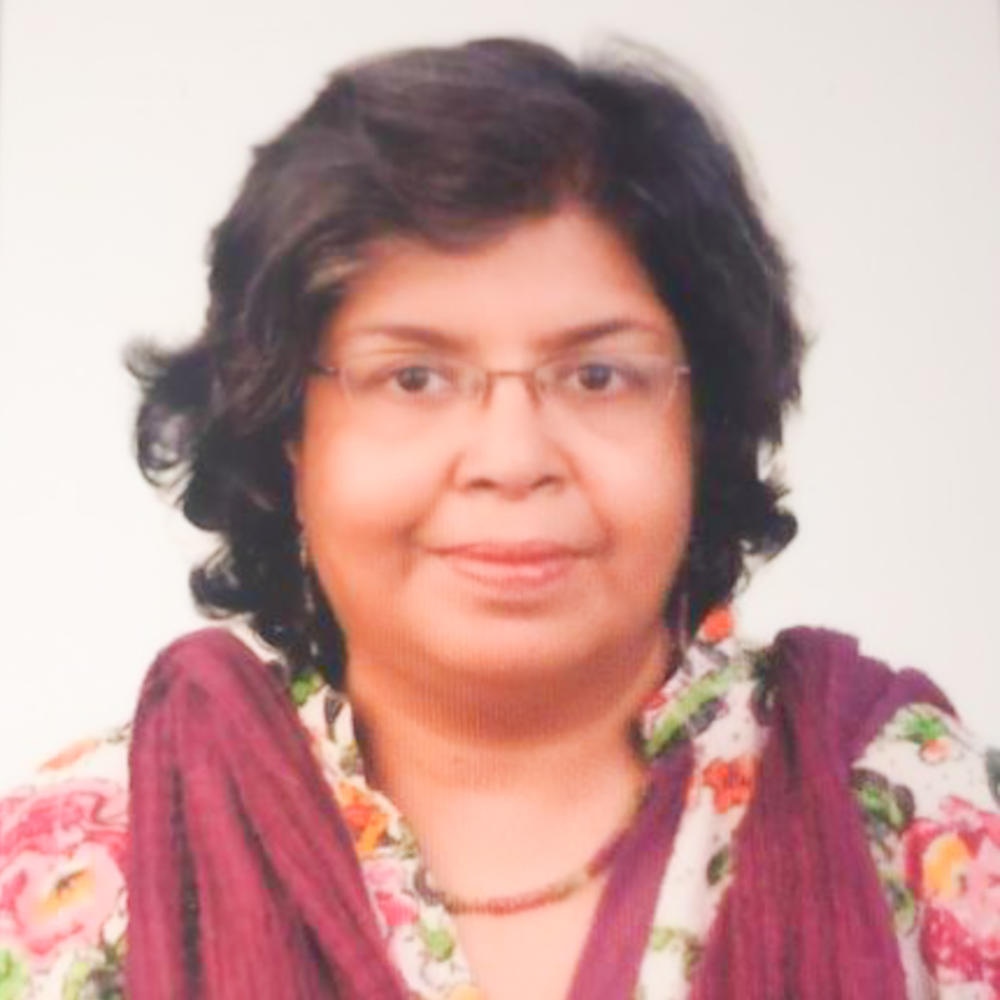
Nirmala Diaz
Since the end of 2020, Nirmala Diaz, a literary scientist (English) and former owner of an advertising agency, has represented the Anthroposophical Society in India.
Nirmala Diaz was born and brought up in Tamil Nadu. She studied at Good Shepherd convent and Stella Maris college, Chennai after which she did post-graduation in English.
Her professional career in advertising began with a stint as a trainee copy writer. She went on to work with various national ad agencies in Chennai and Hyderabad as senior writer and Copy Chief. Along with her husband she started an ad agency, Reachout Communications, and they handled several national accounts.
While at Chennai she was initiated into anthroposophy by Angelika Mandaiker.
Nirmala Diaz, her husband and another friend are the founder trustees of Sloka (The Hyderabad) Waldorf school, India’s first full-fledged Waldorf School, which opened in 1997. She was one of the prime movers of the Rudolf Steiner group, Hyderabad – which was set up in 2011, during the Asia Pacific Conference which they hosted. Nirmala has had links with anthroposophy over the past 30 years.
Sebastian Jüngel As an experienced copywriter, how do you explain this country in a few words or pictures to someone who has never been to India?
Nirmala Diaz India? It’s a country of enchanted lore and Bollywood love song – of clichéd contrasts and vast cities with a crowded patchwork of humanity in dwellings that are so varied, so astounding. A rich masala of mood, history and memories that can be heard aloud.
Loud and beautiful
Loud? Yes! That it is. Tension, traffic, vendors, the throes of living that defies all sense or logic. Beauty? Yes of course – apart from the in your face sunsets and dancing beaches it is everywhere if you can behold it.
SJ From a distance, India seems to be both a very traditional and a very modern (Western-style) society. Where do you locate Indian culture?
ND India? It is in the blood, the rhythm, the eloquence – that can flavour lifetimes. Indian culture has always been inclusive – all the travellers, merchants and historians, warriors and warlords, Kings and Moghuls have sashayed through India and left a mark.
SJ India is a very large and complex country – or rather a confederation of states or cultures? What holds it together? Where do the tensions lie?
ND V.S. Naipaul has called India a wounded civilization. Yes! Anything that has lived is wounded. But in India, wounds have healed with solidarity and bonds and celebration. Barren laid wastelands had risen and blossomed with the new day, a new order, repeatedly. The Shakti is innate, god-given. We are truly global with deep roots and cultural heritage. We are truly free to be. East and West coexist.
The power to transform
Cities and states are a geopolitical quartering of a massive landmass. Languages, food, livelihood, education, trade and agriculture, the service industry helps to unite India. Vast railway networks, highways, airlines help to carry us across the divide of cultures, food, language, religion, regional differences and political divide.
The angst of living in a densely peopled country, eking a livelihood out of hard foundation has made for aggressive and at times a defensive, reactionary approach among even people who lived in symphony and respected boundaries. A brittle quality, a materialistic disregard for our deepest quality, resilience – the ability to endure and overcome – has carried us through the ages. It is this capacity that sets India apart: this power to transform and arise anew.
SJ Can anthroposophy contribute to the development of the country? In what way?
ND This is the power that Anthroposophy promises in these times for all people. The universality within Anthroposophy is what appeals. It can help and has helped to bridge and provide continuum to understand that spiritual and human can work together. Knowledge of the human being is for the humans to work with, internalise and to transform ourselves. It can be practically applicable in all fields like farming, education, counselling, eurythmy, health and healing. The fire and form is transformed into purposeful will, which manifests in our social initiatives. The healing impulse of Anthroposophy is a source of continuous wonder and gratitude.
SJ Is anthroposophy in India independent – or is it strongly influenced by Europe or through the historical connection with the Theosophical impulse, for example?
ND It has a vibrant young membership, where they joyfully rediscover, work earnestly and intensively in anthroposophy in several groups, bringing their expertise and life experience. We see hope and real interest in how anthroposophy can bring change in everything we do – in how much the power of living or light-filled thought can touch our lives and the people in it.
SJ Is there an anecdote that describes your relationship with your own country?
ND We laugh a lot and it helps us overcome so many challenges and brings us closer together. That glimpse of the divine that we once had is the seed force that is being reborn in us.